For many companies, the first CDP disclosure starts with a simple question: Do we actually need to do this? In most cases, the answer is yes. CDP began as an investor-driven climate transparency initiative and evolved into a widely used component of the sustainability reporting landscape, closely aligned with frameworks such as TCFD, IFRS S2, and GRI. Since 2020, the number of disclosers has increased by roughly 30% annually with more than 22,000 companies, representing more than half of the global market capitalization, disclosing to CDP in 2025. Whether the request to disclose originates from a customer, investor, lender, or internal leadership, CDP has increasingly become the standard mechanism through which companies are
That pressure can make a first disclosure feel high stakes. The questionnaire is detailed, the scoring can seem opaque, and the process often highlights how many internal teams, data systems and processes must collaborate to produce a credible response. The good news is that first-time disclosure does not require perfection. What matters most is understanding what CDP is actually asking for, how the scoring works, and where companies tend to lose points that could otherwise be avoided.
The biggest misconception: scoring is not just about how much you disclose
First-time disclosers often assume CDP rewards volume of information disclosed – it does not. The goal of a first response is rarely to “say everything,” but rather to “clearly demonstrate where the business currently stands.” CDP awards points according to a published set of criteria to measure the maturity of a company’s response to each question.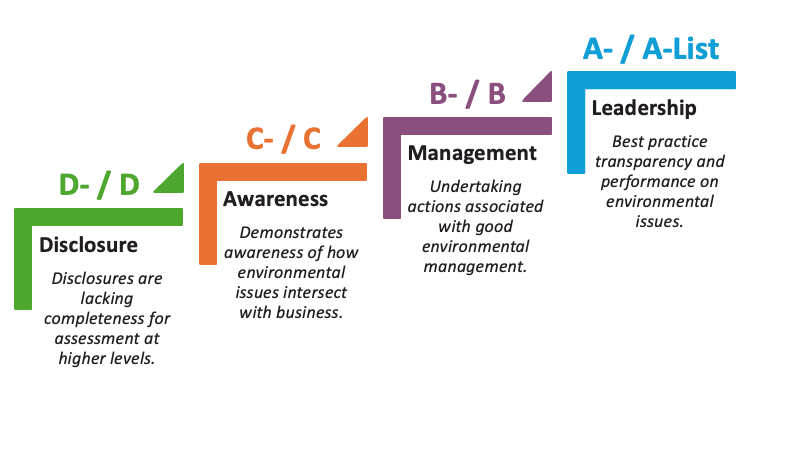 Companies at the C level may identify climate risks, report emissions, and set goals to establish targets and seek verification in the next two years. Companies at the B level demonstrates more formal governance, documented procedures, target tracking, and integration of climate considerations into business processes. At the A level, climate
considerations are strategically embedded across the organization, supported by credible targets, and demonstrate an influence that extends beyond the company’s own operations.
Progressing through these levels is not about writing longer responses. It is about providing qualitative evidence of how climate considerations are managed and integrated into the business.
Consistency matters more than many companies expect
One of the most common ways companies lose points is through inconsistency in question responses. Qualitative questions benefit from clear, structured responses following a logic such as Situation, Task, Action, Result/Review. Even well-written narratives can still miss scoring criteria if they do not directly address specific elements of the prompt.
Quantitative questions present a different challenge – data must reconcile across the entire questionnaire. Total emissions, energy use, and related figures should align wherever they appear. Discrepancies between responses can raise questions about data quality or internal controls, and the company will lose points.
For first-time reporters, this is one of the most practical lessons. Before submission, responses should be reviewed less like a narrative report and more like an audited package. Metrics should be defined consistently and tell the same story in every response.
Timing is tighter than it looks
With the question bank set to release mid-April, the time to begin preparing is now. First-time reporters often underestimate how long it takes to coordinate internal contributors, gather supporting evidence, confirm data, review narrative responses, and resolve inconsistencies. By the time the disclosure window opens in June, companies should already know who owns governance modules, who owns emissions data, who can speak to strategy and risk, and who is responsible for reviewing and approving the final submission.
This is especially true when the disclosure depends on external assurance, target validation, enterprise risk processes, legal review, or executive signoff. While the disclosure is submitted through a single portal, the evidence needed to support it usually lives across multiple functions, including finance, sustainability, legal, operations, procurement, facilities, and executive leadership.
What first-time disclosers should prioritize
If this is your first year, the primary objective should be credibility and internal coordination rather than score maximization.
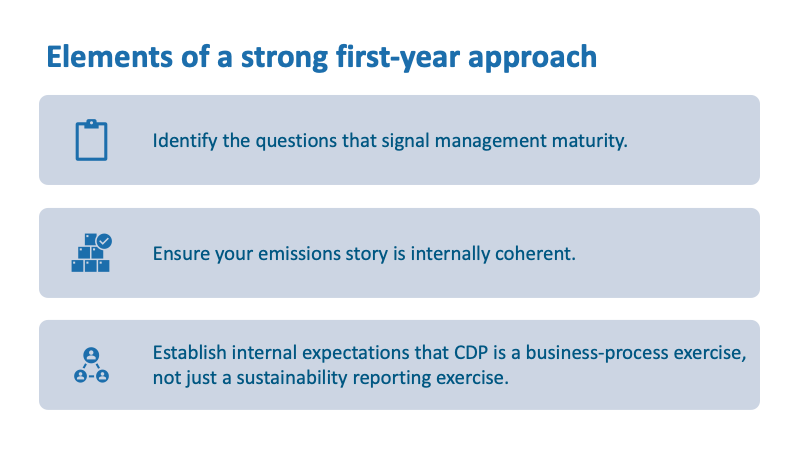 In many cases, the most valuable outcome of a first disclosure is not the grade itself. Instead, the process reveals where governance is still informal, where data collection is weak, and where strategy and environmental reporting remain disconnected. That visibility is often what enables meaningful improvement in the second year.
For first-time disclosers, CDP can be a complex and demanding process. GSI can help ease that burden by offering disclosure support, by mock-scoring questionnaire drafts to bring greater transparency to the scoring process, and by providing strategic assistance in communicating reasonable expectations to internal and external stakeholders. For companies with prior CDP disclosure experience, GSI also brings a strong track record in supporting grade improvement efforts and has even helped clients raise their score by a full letter grade.