What Is Due Under SB 253 on November 10, 2026?
Scope 1 and Scope 2 emissions reports under California’s Climate Corporate Data Accountability Act (SB 253) are due November 10, 2026. CARB has now issued the guidance, filing options, and intake tools companies need to determine whether they must report and how to submit for the first reporting cycle.
Below is a brief outline of everything preparers need to know in order to meet upcoming compliance deadlines, including CARB’s most significant update on September 1 containing the resources companies need to file for 2026.
Who Must Report Under California SB 253 in 2026?
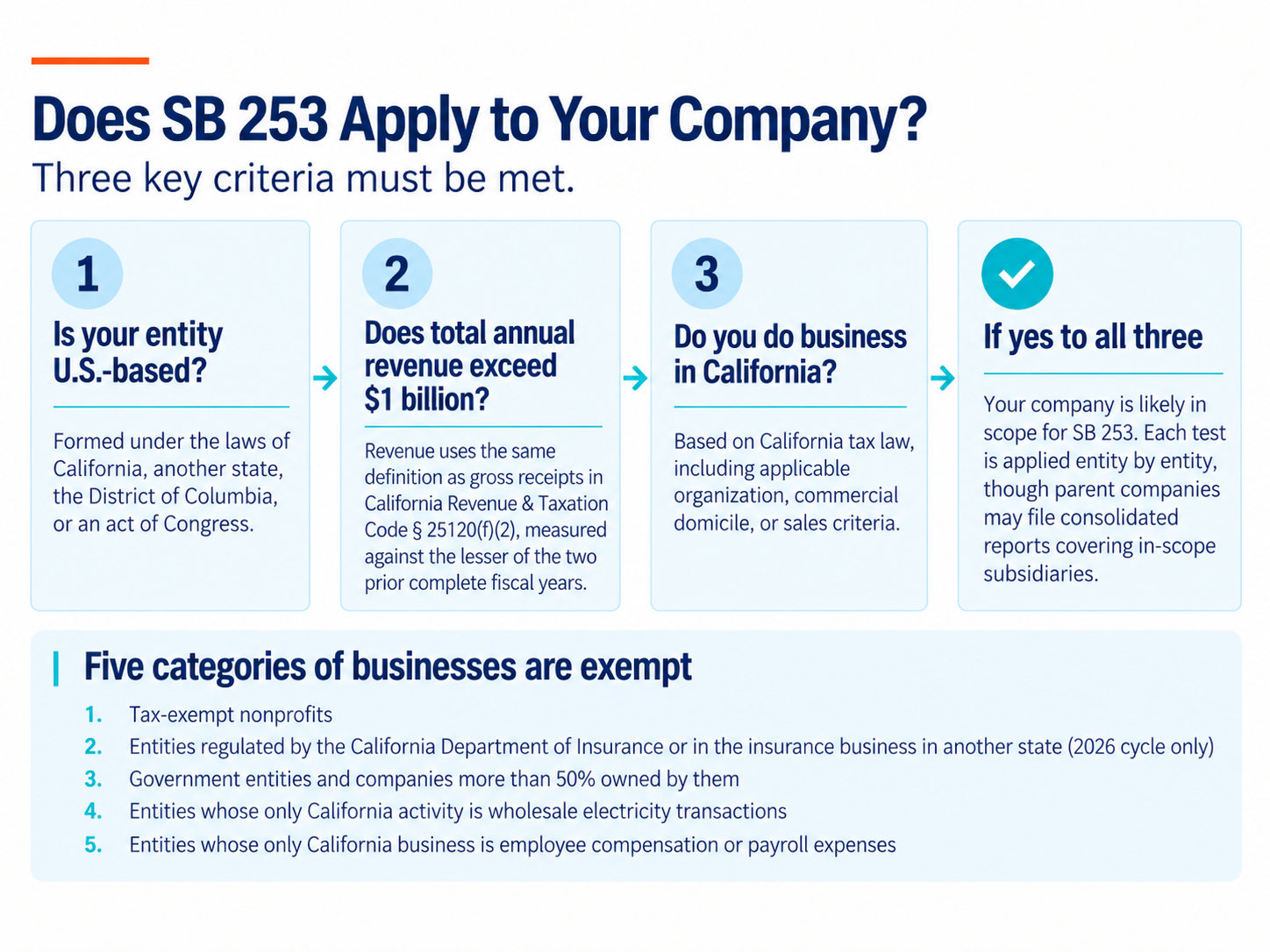
Companies are in scope for California’s corporate GHG reporting requirements if they meet all three criteria below:
- The entity must be U.S.-based (formed under the laws of California, another state, the District of Columbia, or an act of Congress).
- It must have total annual revenue above $1 billion, with “revenue” using the same definition as gross receipts in California Revenue & Taxation Code § 25120(f)(2) and applicability measured against the lesser of the entity’s two prior complete fiscal years.
- It must be doing business in California under existing tax law (defined as California sales of at least $735,019 or 25% of total sales)
Each test is applied entity by entity, though parent companies may file consolidated reports covering in-scope subsidiaries (fees are still assessed individually).
Five categories of business are considered exempt: (1) tax-exempt non-profits; (2) entities regulated by the California Department of Insurance or in the insurance business in any other state; (3) government entities and companies majority-owned (more than 50%) by them; (4) entities whose only California activity is wholesale electricity transactions; and (5) entities whose only California business is employee compensation or payroll expenses, including teleworking employees.
Note that the insurance exclusion at this time applies to the 2026 cycle only. As of July 21, CARB has determined that the existing Department of Insurance reporting does not satisfy SB 253 and has proposed removing the reporting exemption beginning in 2027. For now, insurers should assume they will need to report.
Do All Companies in Scope Have to Submit GHG Emissions Data in 2026?
Being in scope does not necessarily mean submitting emissions this year. Under CARB’s December 5, 2024 Enforcement Notice, first-year reporters may submit Scope 1 and Scope 2 emissions based only on information they already possessed or were already collecting as of December 5, 2024, with or without assurance. Entities that were neither collecting that data nor planning to collect it as of December 5, 2024, are not expected to submit emissions data at all for the 2026 cycle.
Not collecting data does not exempt an entity from filing with CARB. Companies in that position must provide a short statement on company letterhead confirming that they were not collecting, and did not plan to collect, Scope 1 and Scope 2 data when the Notice was issued.
This statement can be filed through the intake platform or emailed to CARB before November 10, 2026.
How Do Companies Submit SB 253 Reports to CARB in 2026?
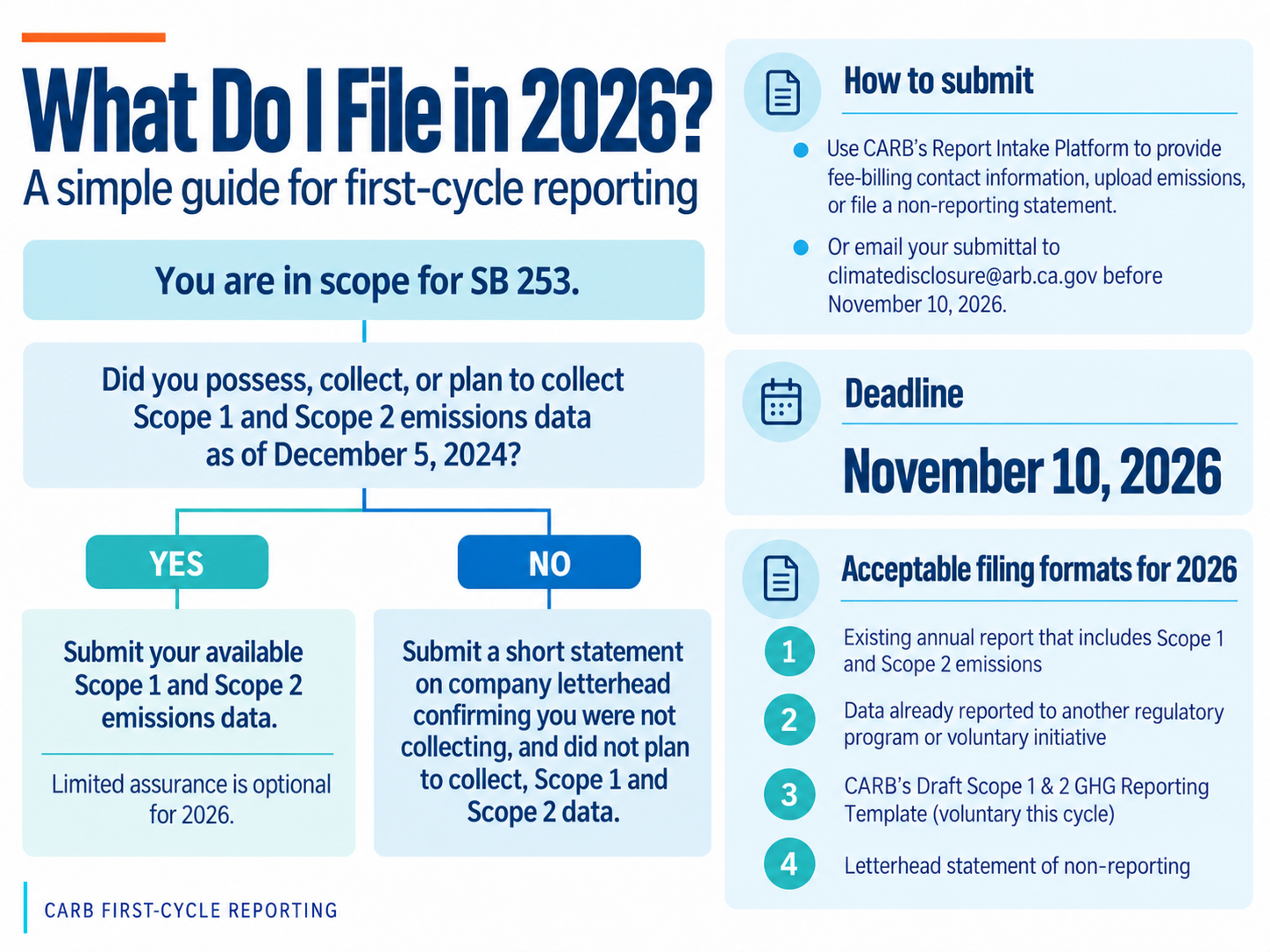 On September 1, CARB released its most directive guidance to date regarding how preparers should submit their filing to CARB for 2026. As part of that release, the Report Intake Platform was made public, which entities can use to provide fee-billing contact information, upload emissions, or file a non-reporting statement. Note that submittals may also be emailed directly to climatedisclosure@arb.ca.gov.
Four formats are acceptable this year: an existing annual report that already includes Scope 1 and Scope 2 emissions, data already reported to another regulatory program or voluntary initiative, CARB’s Draft Scope 1 & 2 GHG Reporting Template (posted October 10, 2025 and voluntary this cycle), or the letterhead statement of non-reporting described above.
CARB clarified that no specific emission factor dataset is required for 2026: because U.S. EPA has not released eGRID 2024 on its usual timeline, CARB will accept eGRID 2023, the eGRID 2024 dataset published by the Cornerstone Sustainability Data Initiative, or another credible source, so long as the factors and their sources are identified.
Additionally, CARB will accept submittals regardless of whether limited assurance was obtained.
What Will Change for California SB 253 Reporting in 2027?
The 2026 guidance applies only to the first cycle. Everything after is being built through a separate rulemaking, previewed at CARB’s July 21, 2026 workshop, with a draft regulation expected later this year. That being said, CARB has provided stakeholders an idea of what to expect for the upcoming year.
In addition to Scope 1 and 2 emissions reporting, CARB has proposed requiring the five most commonly reported Scope 3 categories beginning in 2027: purchased goods and services, fuel- and energy-related activities, waste generated in operations, business travel, and employee commuting (Categories 1, 3, 5, 6, and 7, respectively). The other 10 would remain voluntary.
Limited assurance is expected to shift from voluntary to mandatory, with reports submitted in 2027 requiring third-party assurance of Scope 1 and Scope 2 emissions under an approved standard.
Beyond that, expect a recurring November 10 deadline, close alignment with the GHG Protocol Corporate Standard, Scope 2 Guidance, and Scope 3 Standard, deliberate interoperability with IFRS S2 and the EU CSRD, and Scope 2 disclosure under both market-based and location-based methods.
As mentioned above, insurance companies are expected to come back into scope starting next year, with CARB proposing that they satisfy both CARB and Department of Insurance requirements through a single report, supplemented as needed to cover Scope 3 and assurance.
Note that all of these updates are contingent on a favorable outcome on the existing Ninth Circuit litigation that is continuing in the background. Until the courts rule otherwise, SB 253 is still in effect, and companies should plan on reporting.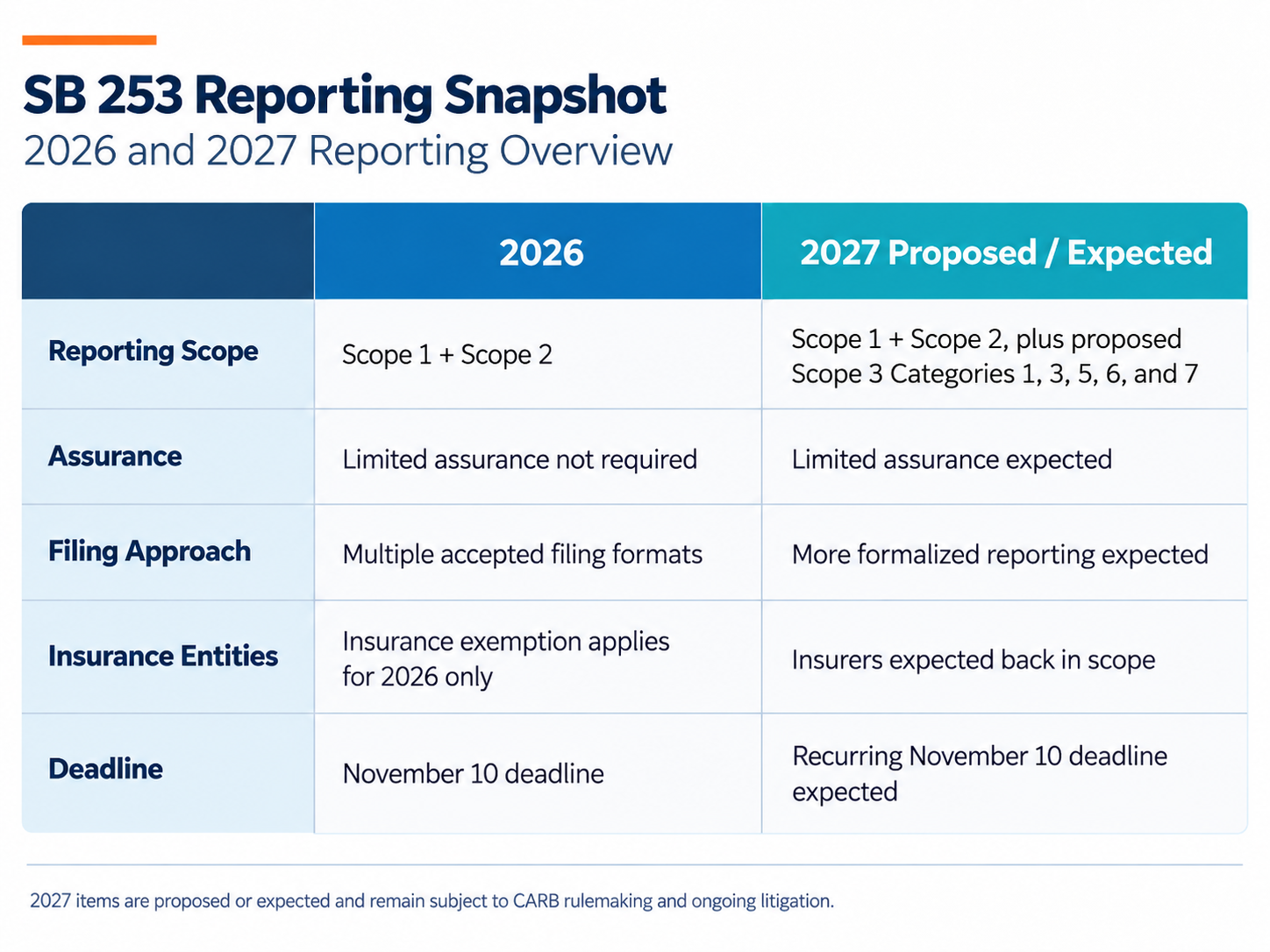
How GSI Environmental Supports SB 253 and California GHG Reporting Compliance
GSI Environmental can support clients at each stage of the reporting process, from determining applicability and organizing emissions data to preparing disclosures and planning for assurance. Our multidisciplinary team of engineers, scientists, accountants, and MBAs includes CARB-accredited Lead GHG Verifiers serving clients across real estate, retail, manufacturing, energy, healthcare, technology, and the public sector.
Among many services, our team is equipped to calculate Scope 1, 2, and 3 inventories, develop Inventory Management Plans, and provide limited assurance and verification ahead of the 2027 requirement.
We also support Scope 3 readiness and supply-chain engagement, SB 261 climate risk reporting and scenario analysis, CSRD and CDP disclosure, and decarbonization planning.
California SB 253 and CARB GHG Reporting Resources
For further information about the status of California’s GHG Reporting Program, make sure to explore CARB’s resources page.