Insights from the 2026 EPR Think Tank West Coast
Packaging EPR is becoming an operating requirement across a growing number of states.
While packaging has long been regulated in sectors such as food and pharmaceuticals, a broader range of industries must now manage packaging as part of their regulatory scope. EPR changes that equation by making packaging data part of the producer’s compliance and financial responsibilities. Packaging decisions now affect reporting obligations, producer fees, source reduction requirements, and ultimately product economics. As a result, packaging is increasingly becoming both an operational asset as well as a compliance mechanism.
That was one of the clearest messages from the 2026 EPR Think Tank West Coast in San Francisco. Seven states have now enacted packaging EPR programs, including California, Colorado, Oregon, Minnesota, Maine, Maryland, and Washington. While the programs share a common premise, requiring producers to take greater financial and operational responsibility for packaging at end of life, the details differ significantly by state.
For companies selling products across multiple jurisdictions, the challenge is therefore bigger than complying with another environmental regulation. EPR is becoming a cross-functional business process touching packaging design, procurement, supply-chain data, finance, legal, sustainability, IT, sales, and product strategy. Companies must also determine how they will manage compliance risk as requirements vary by state.
The companies best positioned for this shift will be those that stop treating EPR as an annual reporting exercise and start building the governance and data systems needed to manage it continuously.
One EPR concept, multiple state systems
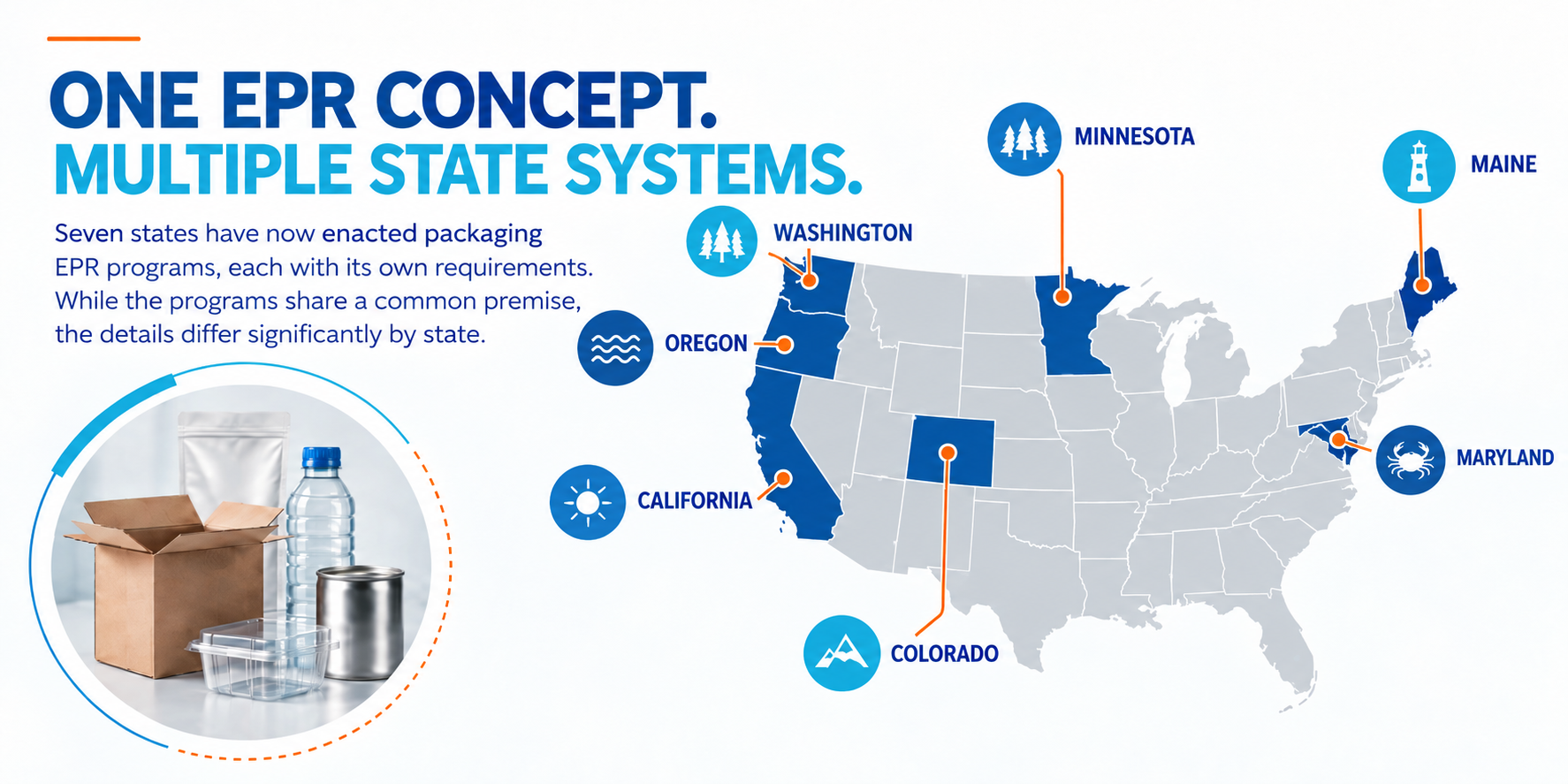 There is growing alignment across state programs, particularly around the use of producer responsibility organizations (PROs), packaging reporting, and material categories. But harmonization has limits.
Producer definitions, exemptions, covered materials, treatment of business-to-business packaging, fee structures, source-reduction requirements, recyclability standards, and enforcement mechanisms can all vary. Regulators are working together to align implementation where possible, but they remain bound by their individual state statutes.
The internal system can be harmonized even when the laws are not.
Rather than creating a separate compliance process for every state, companies can build one controlled source of truth for the packaging inventory, then translate that information into the specific requirements of each jurisdiction. However, some qualitative details like brand ownership, manufacturing, importing, distribution arrangements, private-label relationships, and even where a company sits in the supply chain can influence compliance obligations. Therefore, it is paramount that companies achieve internal agreement on these discussion points where a database might not necessarily provide all the answers.
This analysis also cannot be static and must evolve over time. Changes to products, suppliers, ownership structures, sales channels, regulations, or contracts can change the answer and processes must be put in place to account for the dynamic nature of packaging and customer demands.
Packaging data is becoming compliance infrastructure
Many of the first EPR reporting cycles exposed an uncomfortable reality: the current paradigm of packaging sales data does not meet the technical rigor for EPR compliance.
In trying to comply with EPR requirements, companies described difficulties such as information distributed across multiple vendor systems, outdated product drawings, supplier records, spreadsheets, incomplete bills of materials, and product teams that may make packaging decisions without considering future reporting requirements.
That matters because EPR reporting increasingly requires companies to understand much more than the total weight of packaging sold.
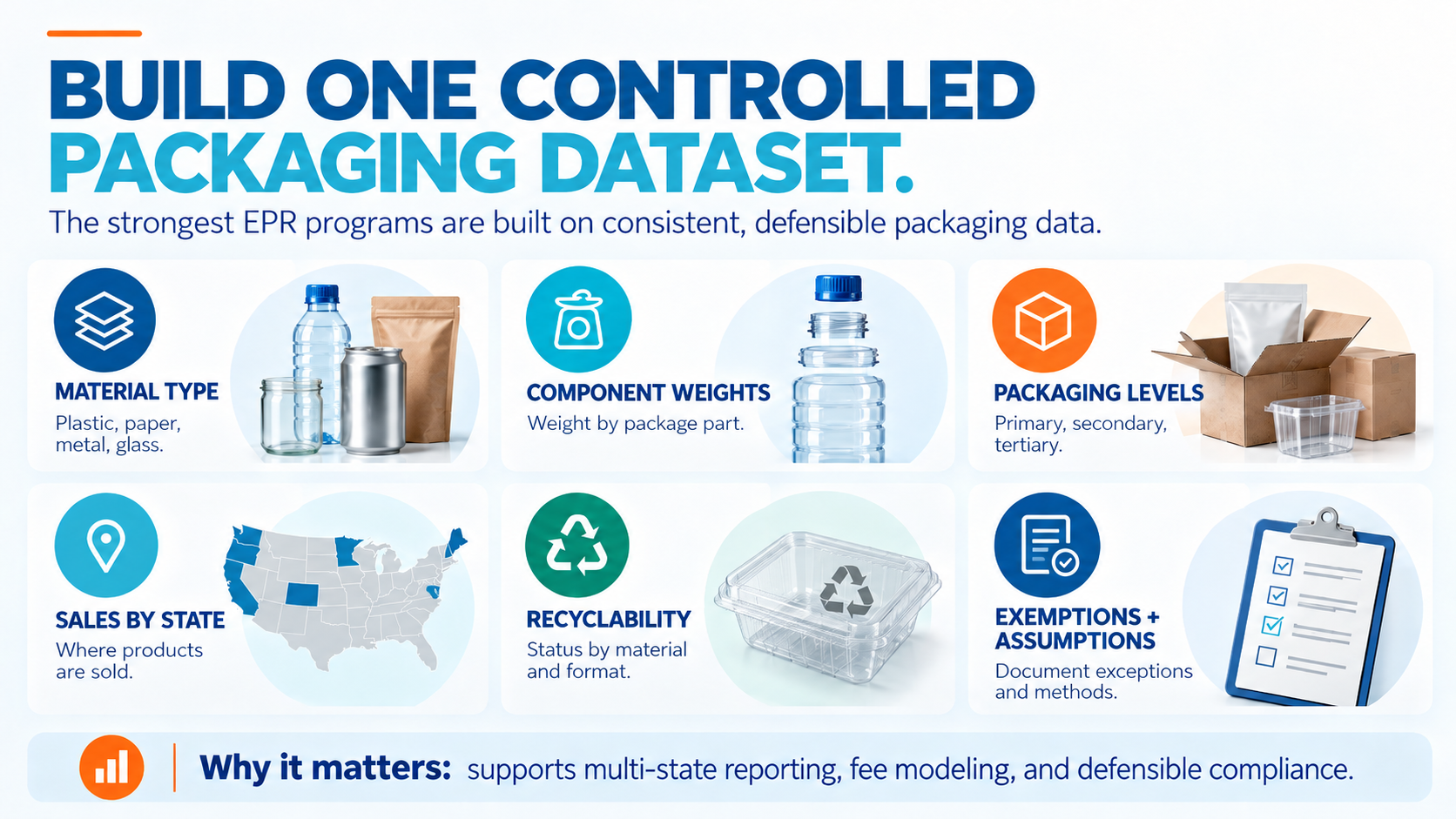
Depending on the program, companies may need to know:
- packaging component and material type
- individual component weights
- primary, secondary, tertiary, case-pack, and inner-pack packaging
- sales and distribution by state
- producer and brand-owner relationships
- applicable exemptions
- recyclability characteristics
- recycled content
- supplier assumptions and calculation methodologies
- historical packaging configurations used for baselines
The goal should therefore be to develop a packaging inventory master dataset, not assemble a new spreadsheet from various sources for each reporting cycle.
 The data also needs controls. Supplier information should be checked where risk is highest, particularly for high-volume products, high-fee materials, unusual weights, multi-component or substrate complexity, or assumptions applied broadly across many SKUs.
A useful test is whether the company can clearly explain how the report was prepared, including the source records, data treatments, assumptions, calculations, and review controls.
Because EPR audit and substantiation expectations are still developing, no single test establishes that a reporting process is defensible. However, maintaining clear documentation and controls can help a company explain its methodology, evaluate data quality, and support the information it submits as regulator and PRO expectations evolve.
Governance may be one of the most important EPR controls
Managing EPR requires coordination across the business:
- regulatory and sustainability teams interpret requirements
- procurement and suppliers provide packaging information
- IT retrieves data
- packaging and R&D influence design
- finance evaluates fees
- sales data supports state allocations
- legal assesses producer responsibility and contractual obligations
Without clear ownership, gaps appear between these functions.
One of the strongest themes across the conference was therefore governance. Companies were encouraged to establish an executive sponsor, a designated EPR program owner and backup, defined data owners, review and approval responsibilities, escalation procedures, and a shared compliance calendar.
This is not administrative housekeeping. It is a risk-control mechanism.
Good governance creates evidence that a company has established a reasonable process to understand its obligations, review assumptions, correct errors, respond to notices, and maintain compliance as requirements change.
It also reduces reliance on individual institutional knowledge. If the person who prepared last year’s report leaves, the methodology should remain.
EPR costs are becoming packaging-design signals
EPR fees are also beginning to change the economics of packaging.
Initial fees may largely reflect material type and weight, but eco-modulation can increasingly reward or penalize attributes such as recyclability, recycled content, source reduction, package design, or recovery performance.
That means EPR should not sit only in a sustainability or regulatory budget.
Companies should begin modeling potential fees at the SKU or material level and connect those scenarios with procurement, pricing, product margins, packaging redesign, and capital planning.
Waiting for every final fee schedule may be tempting, but implementing packaging changes can take years. Product testing, manufacturing changes, supplier qualification, artwork revisions, and equipment investments all create long lead times.
Several discussions therefore focused on no-regret actions that companies can evaluate now, including eliminating unnecessary packaging, lightweighting, simplifying difficult material combinations, improving packaging specifications, and testing redesign alternatives.
The objective is not to redesign everything immediately. It is to understand where regulatory exposure and packaging economics are beginning to converge.
“Recyclable” increasingly means the whole system works
Another important shift is the definition of recyclability itself.
A material may be technically capable of being recycled and still fail in practice if consumers cannot access collection, facilities cannot sort it, contamination prevents processing, or no viable end market exists.
California’s SB 343, although its enforcement is currently blocked by a federal preliminary injunction, illustrates the broader policy direction of packaging recyclability and having supporting documentation for those claims rather than simply relying on technical recyclability alone.
The broader EPR infrastructure discussions reached the same conclusion.
EPR can provide stable financing for collection, processing, alternative collection systems, and infrastructure upgrades. It can help expand access and potentially create new pathways for difficult materials such as films and flexible packaging.
But regulation alone does not make a material circular.
There still needs to be a functioning chain from design to collection, processing, responsible end markets, and ultimately demand for the recovered material.
For companies considering packaging changes, this systems perspective is important. Replacing one material with another simply because it appears easier to classify as recyclable can create unintended lifecycle, climate, or customer demand tradeoffs. Packaging decisions should consider material use, functionality, greenhouse gas impacts, end-of-life performance, infrastructure availability, and market demand together.
Litigation is important, but it is not a compliance strategy
EPR laws are also being challenged in multiple jurisdictions.
Legal challenges are developing across several state packaging programs, and their outcomes could affect implementation. Companies should monitor those cases closely, but litigation should not replace compliance planning. An injunction or pending case may affect a particular requirement, enforcement mechanism, or group of regulated entities without eliminating the broader need to prepare. Companies should therefore understand exactly what a court decision changes before adjusting their compliance strategy.
Companies should stay engaged in rulemaking and implementation. Regulators repeatedly indicated that producer input can be valuable when a requirement does not reflect the technical reality of a product, packaging format, or supply chain. A detailed technical case study supported by evidence is generally more useful than simply commenting that compliance is difficult.
The next phase of EPR is operational
The most significant takeaway from the conference was not a particular deadline, fee, court case, or material classification.
It was that EPR is becoming an enterprise management discipline.
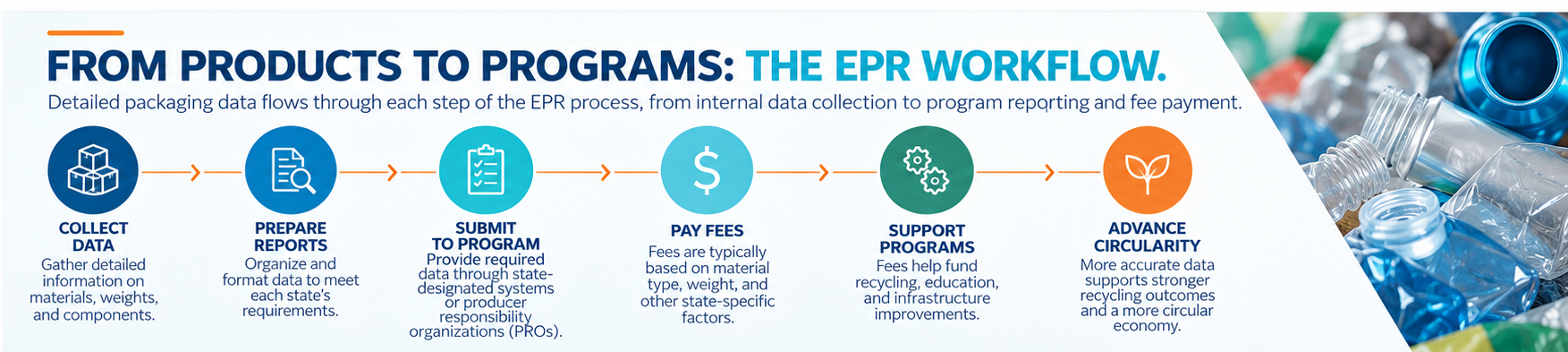
For many companies, the immediate priorities are to:
1. Determine producer responsibility by state and product.
2. Create a controlled packaging and sales dataset that can serve multiple jurisdictions.
3. Document methodologies, assumptions, exemptions, and supporting evidence.
4. Establish executive oversight and clear cross-functional responsibilities.
5. Review supplier and customer agreements for EPR responsibilities, data obligations, fees, and liability.
6. Model potential EPR costs, budget for them accordingly, and connect them to packaging and business decisions.
7. Monitor regulations, PRO guidance, litigation, and enforcement throughout the year rather than only near filing deadlines.
The strongest EPR programs will not be those that predict every regulatory change correctly. They will be the ones capable of absorbing change without losing control of their data, decisions, deadlines, or accountability.