EcoVadis was founded in 2007 and launched in Paris[8]; it has since grown into a global provider of business sustainability ratings used in supply chains. [9] EcoVadis describes its sustainability assessment as a paid service delivered through registration, questionnaire, expert analysis, and results. [10]
Methodologically, EcoVadis evaluates the quality of a company’s sustainability management system through Policies, Actions, and Results, and it operationalizes these through seven management indicators (Policies, Endorsements, Measures, Certifications, Coverage, Reporting, and 360° Watch Findings). [11] The framework covers up to 21 criteria grouped into four themes:
-
- Environment
- Labor & Human Rights
- Ethics
- Sustainable Procurement
The assessed criteria is tailored to the individual company profile and risk context [12] and translated into a verified score from 0 to 100. Disclosing companies receive medals or badges based on percentile ranking relative to peers. Medal thresholds are percentile-based across all assessed companies in the prior 12 months: Platinum (top 1%), Gold (top 5%), Silver (top 15%), Bronze (top 35%). [15]
EcoVadis is not a public sustainability reporting platform; rather it is a procurement-facing management system assessment. Its purpose is to help buyers understand whether a supplier has credible, functioning sustainability programs in place.
Evidence rules are unusually practical (and that’s the point!). EcoVadis says supporting documents should be recent, relevant, complete, and aligned to the scope of evaluation, and it provides examples such as sustainability procedures, audit reports, HSE policies, codes of conduct, employee handbooks, and ISO certificates. [13]
Why EcoVadis matters in procurement, risk, reputation, and regulation
EcoVadis is designed around supplier assessment and scorecard sharing with trading partners, and it positions its ratings as analyst-validated supplier assessments with continuous improvement tooling. [16] For suppliers, EcoVadis often becomes a market access gate: not a complete measure of sustainability, but a standardized proxy for whether management systems exist, operate, and can be evidenced. [17]
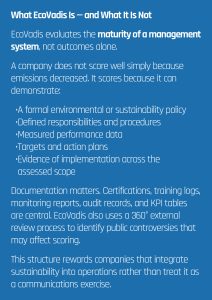 It is also a reputational and compliance signal. EcoVadis describes 360° Watch as a complementary screening using external stakeholder inputs and notes that significant cases (for example, fines or sanctions) can affect theme scores based on severity. [2] This tends to reward companies that can demonstrate preventive controls, corrective action discipline, and clean documentation, not just aspirational policies.
Regulation is pushing the same direction. The European Commission[18] describes EU corporate sustainability reporting rules as requiring large and listed companies to report on sustainability risks and on impacts to people and the environment, supported by standards covering the full ESG range. [19] Even where a supplier is not directly in scope, customer requests commonly cascade through value chains.
EcoVadis in the sustainability reporting ecosystem
EcoVadis sits alongside sustainability disclosure frameworks and standards by focusing on the verifiable management system underneath the narrative. Global Reporting Initiative (GRI) [20] provides a broad impact reporting framework across economic, environmental, and social topics. [21] The International Sustainability Standards Board[22] IFRS S1 and IFRS S2 standards focus on sustainability-related and climate-related financial disclosures for capital markets, and the Sustainability Accounting Standards Board[23] standards are maintained as industry-based guidance under the ISSB ecosystem. [24]
Practically, the payoff is consolidation
EcoVadis’ methodology materials emphasize alignment with these global frameworks and standards and an evidence-based approach that combines company documentation, third-party endorsements, and external monitoring inputs. [25] Practically, the payoff is consolidation: one well-governed data and evidence system can serve EcoVadis, CDP, GRI-based reporting, and CSRD-aligned customer data demands, reducing the annual scramble. [26]
Another way to look at the strategic advantage of EcoVadis is illustrated by the graphic below. Sustainability expectations cascade through markets: regulations and competitive pressures apply first to companies directly in scope, and those companies then pass requirements down to their suppliers through questionnaires, data requests, and ESG ratings such as EcoVadis. Procurement departments use EcoVadis as a standardized comparison tool to evaluate the maturity of suppliers’ sustainability management systems across environmental, labor, ethics, and procurement criteria. When two suppliers offer comparable products or services at similar cost and quality, but one holds an EcoVadis medal and the other has not submitted at all, the rated supplier provides greater transparency, verified documentation, and lower reputational and regulatory risk. If stakeholders or investors prioritize sustainability performance, procurement is far more likely to select the supplier with the demonstrated, externally assessed management system, as it signals governance strength, operational controls, and alignment with evolving market expectations.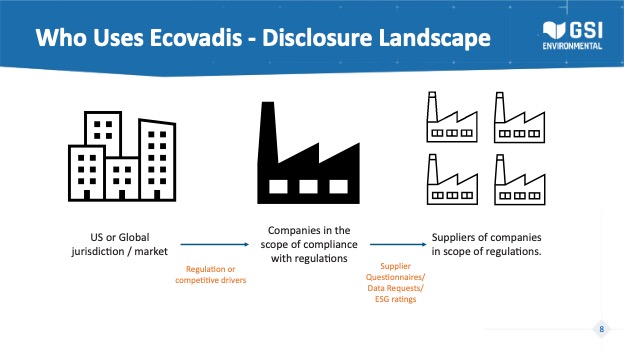
Mapping EcoVadis expectations to environmental engineering deliverables
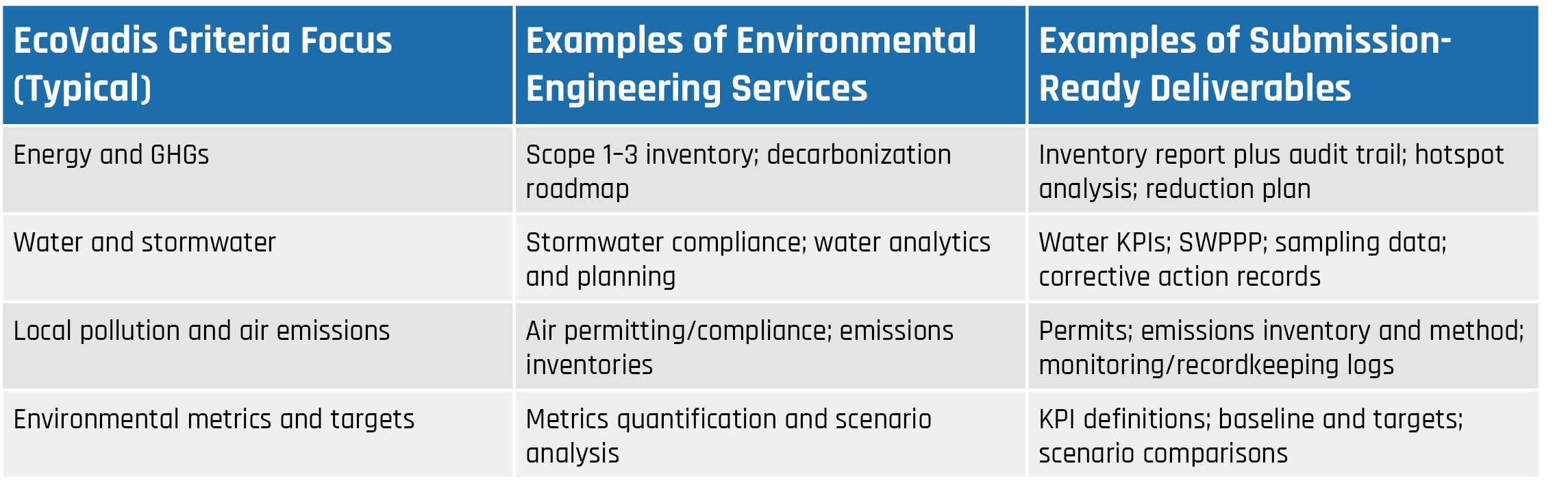
 EcoVadis’ “Coverage” concept rewards programs that are deployed consistently across the assessed scope, not just piloted at one facility. [27] That makes operational measurement and compliance programs disproportionately valuable because they create repeatable, auditable evidence: plans and procedures, monitoring logs, results tables, and corrective action records. [28] A practical maturity-building pattern is to treat each relevant EcoVadis criterion as a small “evidence pack” spanning policy, process, KPI results, training/communication, and proof of deployment.
Environmental Metrics Quantification establishes clear definitions, calculation methods, and data controls for key sustainability indicators so that performance results are accurate, consistent across facilities, and comparable over time. This structure strengthens the quality and defensibility of EcoVadis “Results” and “Reporting” responses by ensuring that data is traceable and decision-relevant.
On the operational side, technical compliance work provides the documented evidence that EcoVadis expects. Air services generate permitting records, emissions inventories, monitoring logs, and regulatory reports. Stormwater programs produce compliance strategies, employee training records, sampling data, SWPPPs, corrective action plans, and centralized data systems that house analytical results and supporting documentation. Together, these materials demonstrate that environmental policies are not only written, but actively implemented and monitored.
Practical submission plan, timeline, and evidence library
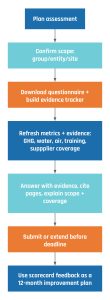 EcoVadis provides a 30-business-day submission window once the questionnaire opens, but strong submissions are rarely built within those 30 days alone. [33] In practice, companies benefit from beginning preparation at least four months before submission. That longer timeline creates space to identify structural gaps, formalize documentation, and ensure that supporting materials reflect established practices rather than documents created solely for the rating. EcoVadis documentation guidance generally expects that materials demonstrate implementation and maturity, and documents created or dated too close to submission may not be credited in the same way as established records. Beginning preparation early allows organizations to update policies with proper approvals, document training completion, refine KPIs, and implement corrective actions well before the assessment window opens.
EcoVadis is not a one-person exercise
The process of supporting GSI clients with their EcoVadis submissions typically begins with a structured kickoff meeting that brings internal stakeholders together to understand what EcoVadis is, how procurement departments use it, and what evidence expectations look like. EcoVadis is not a one-person exercise. It requires coordinated input across departments with operational knowledge of internal processes and documentation. Facilities may oversee environmental permits and monitoring logs. HR may manage diversity policies and employee training records. EHS may maintain greenhouse gas inventories and compliance documentation. Legal may control codes of conduct and governance procedures. Finance may track risk-related metrics. Frequently, each function operates effectively within its own domain, yet no single individual has visibility into how these materials connect within a sustainability rating framework.
Once relevant stakeholders are identified, focused working sessions help translate questionnaire language into practical documentation. This is where clarity and organization become essential. A facilities manager may not immediately recognize that a stormwater monitoring log satisfies an environmental evidence requirement. HR may not realize that a signed DEI policy requires a visible approval date and defined review cycle to qualify. Greenhouse gas inventories may exist, but ownership and version control may not be clearly defined. These cross-functional reviews take time, but with knowledge of the process and disciplined coordination, documentation can be gathered efficiently and mapped to specific questionnaire requirements.
After documentation is assembled, a consolidated review allows companies to identify short-term improvements before submission. Many gaps are procedural rather than substantive. A training program may exist but lack formal attendance records. A policy may be implemented but missing a signature, date, or company logo. Targets may be tracked internally but not formally documented. It is not uncommon to lose points because a supporting document lacks proper formatting or fails to demonstrate scope coverage. Addressing these issues two months before submission ensures that documentation reflects established implementation rather than last-minute preparation.
When the questionnaire officially opens, the organization shifts into execution mode. During the 30-business-day window, responses should be tightly aligned with available evidence, clearly referenced, and annotated so analysts can easily locate supporting pages and understand coverage statements. [33] Because preparation occurred months in advance, the submission period becomes a structured sprint rather than a scramble.
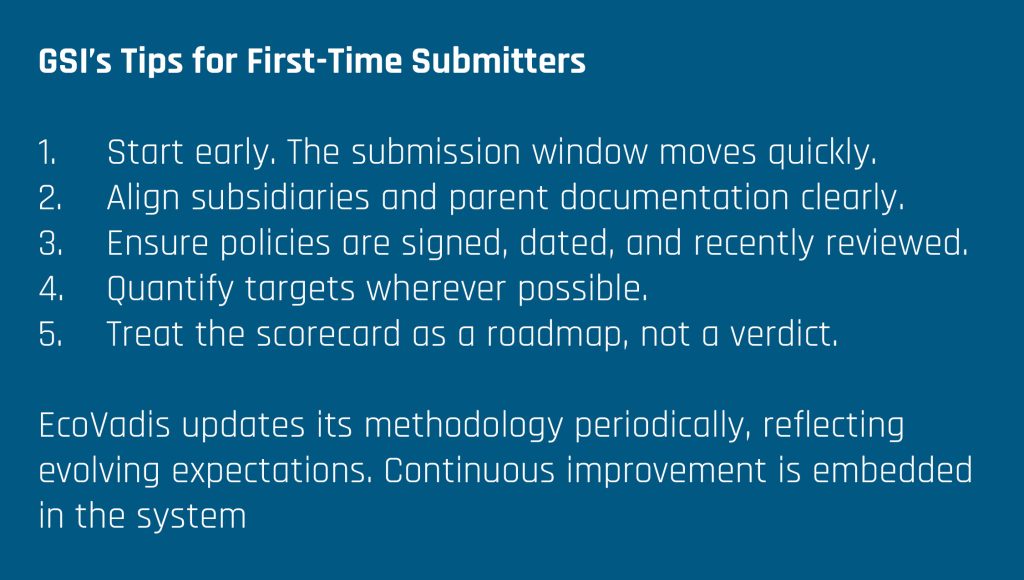
There is, however, an important caveat. Especially for first-time submitters, companies do not know the exact questions they will receive until the questionnaire is released. EcoVadis tailors questionnaires based on industry, size, geography, and risk profile, and the methodology evolves year over year to reflect its commitment to continuous improvement. This means preparation cannot rely on predicting specific questions. Instead, it must focus on strengthening the underlying management system, refreshing core metrics, updating policies, and ensuring documentation is complete, approved, and traceable.
At GSI, we have been able to help companies prepare effectively even before they gain access to their specific questionnaire. Having supported multiple submissions across industries, we understand the recurring themes, common documentation gaps, and typical areas of weakness. While no one can know the exact questionnaire in advance, experience allows preparation to be targeted and strategic. By focusing on foundational policies, measurable results, governance structures, and evidence quality, companies are positioned to respond confidently when the tailored questionnaire becomes available, regardless of minor variations in wording or emphasis. After submission, EcoVadis analysts review the materials and issue a scorecard that includes a 0–100 score, percentile ranking, theme-level breakdown, and medal or badge status where applicable. The scorecard also outlines improvement areas. Rather than treating the result as a final judgment, high-performing organizations use it as a roadmap for the next cycle. Since scorecards are valid for 12 months, companies that maintain documentation continuously, refresh policies on schedule, track environmental metrics consistently, and document training throughout the year find that each subsequent submission becomes more streamlined and more reflective of true organizational maturity. [34]
Starting four months in advance transforms EcoVadis from a compliance exercise into a management systems discipline. The rating rewards established programs, traceable data, and cross-functional coordination. With sufficient lead time, companies can ensure that what is submitted is not only complete, but representative of how sustainability is genuinely embedded within the organization.
Building a Durable Sustainability Management System
EcoVadis reflects a broader shift in how sustainability is evaluated in the marketplace. Sustainability performance is no longer confined to annual reports or marketing materials. It is embedded in procurement decisions, enterprise risk management, lender due diligence, and operational governance. Companies that approach EcoVadis as a one-time compliance task may secure a score, but companies that treat it as an internal systems audit build something more durable. The distinction lies in integration.
Consider two suppliers operating in the same sector with similar products, pricing, and quality. One completes the EcoVadis questionnaire each year by gathering documents in a rush, updating policies only when requested, and treating the exercise as an administrative requirement. The other uses EcoVadis as a structured review of how sustainability is governed across the organization. In the second company, environmental monitoring is tracked routinely, greenhouse gas inventories are updated on a defined schedule, training records are maintained centrally, supplier screening is embedded in procurement workflows, and policies are reviewed annually with documented approvals. The EcoVadis submission in this case does not require new work. It simply reflects work already being done.
The practical implications are significant. Companies with higher EcoVadis scores often demonstrate stronger internal controls and clearer lines of accountability. When a regulatory update occurs, they already have documented procedures and assigned owners. When a customer requests emissions data or water consumption metrics, the information is retrievable and defensible. When a controversy arises in the supply chain, they can point to due diligence processes, supplier codes of conduct, and screening mechanisms. These capabilities reduce operational disruption and reputational exposure.
Resilience emerges from this alignment. Environmental compliance programs reduce the likelihood of violations. Documented greenhouse gas inventories enable scenario planning and transition risk analysis. Structured supplier oversight mitigates downstream exposure to human rights or environmental incidents. Governance frameworks ensure that sustainability considerations are integrated into executive decision-making rather than handled reactively. In this context, a strong EcoVadis score is not the goal itself. It is a byproduct of coherent management systems.
When environmental monitoring, compliance programs, greenhouse gas inventories, supplier oversight, and governance structures are documented and aligned, EcoVadis becomes less of a sprint and more of a reflection of organizational maturity. The rating validates what is already embedded in operations. That shift from reactive disclosure to integrated management is where long-term value is created, because the company is not merely responding to external pressure. It is building systems that anticipate it.
[1] [17] https://resources.ecovadis.com/ecovadis-solution-materials/csr-rating-methodology-scoring-principles
[2] https://support.ecovadis.com/hc/en-us/articles/115005125328-How-the-360-Watch-Findings-works
[3] [6] [11] [23] [32] https://support.ecovadis.com/hc/en-us/articles/115002531507-What-is-the-EcoVadis-methodology
[4] [7] [8] [12] [18] [25] https://resources.ecovadis.com/whitepapers/ecovadis-ratings-methodology-overview-and-principles-2022-neutral
[5] [22] https://www.gsienv.com/services/sustainability-climate/ghg-and-climate-services/
[9] https://ecovadis.com/about-us/
[10] https://support.ecovadis.com/hc/en-us/articles/115002653188-What-is-the-EcoVadis-assessment-process
[13] [28] [35] https://support.ecovadis.com/hc/en-us/articles/210460307-Understanding-supporting-documents
[14] [33] https://support.ecovadis.com/hc/en-us/articles/210459457-How-long-does-it-take-to-complete-the-questionnaire
[15] https://support.ecovadis.com/hc/en-us/articles/210460227-Understanding-EcoVadis-Medals-and-Badges
[16] https://ecovadis.com/solutions/ratings/
[19] https://finance.ec.europa.eu/capital-markets-union-and-financial-markets/company-reporting-and-auditing/company-reporting/corporate-sustainability-reporting_en
[20] [21] https://www.globalreporting.org/
[24] https://www.ifrs.org/issued-standards/ifrs-sustainability-standards-navigator/ifrs-s1-general-requirements/
[26] https://www.cdp.net/en/disclose/question-bank
[27] https://d2uars7xkdmztq.cloudfront.net/app_resources/54766/documentation/194666_en.pdf
[29] https://www.gsienv.com/services/sustainability-climate/
[30] https://www.gsienv.com/services/sustainability-climate/environmental-metrics-quantification/
[31] https://www.gsienv.com/services/air/
[34] https://support.ecovadis.com/hc/en-us/articles/11564680007442-What-happens-after-you-get-a-scorecard