Municipalities carry climate responsibilities that extend far beyond those of individual businesses. They serve whole communities, including residents and local businesses, and can’t simply “pause operations” during disruptions or “shut down” if climate conditions get worse. Local governments also serve as a conduit for community-wide action, coordinating cross-sector efforts and investing in shared infrastructure when private-sector action is uneven or limited in scope. Residents depend on these efforts for everything from storm preparation and wildfire response to flood control, cooling centers, infrastructure upgrades, and programs that help stabilize insurance and utility costs. They also help local businesses prepare for new environmental regulations. For many communities, Climate Action Plans (CAPs) and Climate Action and Adaptation Plans (CAAPs) provide a structured framework for prioritizing investments, securing funding, coordinating across departments, and tracking progress over time.
By 2050, urbanization and population growth could add about 2.5 billion people to urban areas, with estimates suggesting roughly 68% of the world’s population will live in cities. Urban growth concentrates people, infrastructure, and economic activity in hazard-exposed areas, and a single climate event can strain multiple community services at once. This makes proactive planning increasingly important. What is a Climate Action Plan (CAP) or a Climate Action and Adaptation Plan (CAAP)?
A Climate Action Plan (CAP) is a strategic roadmap that municipalities use to identify actions local government and community partners can take to reduce greenhouse gas (GHG) emissions and strengthen infrastructure and services in response to climate change. Municipalities at the beginning of their sustainability journey commonly emphasize mitigation efforts, such as reducing emissions. As climate planning and sustainability programs mature and new challenges develop, CAPs are often expanded into Climate Action and Adaptation Plans (CAAPs). CAAPs combine efforts to reduce emissions with adaptation and resilience measures to address climate impacts and maintain the continuity of essential community services. CAAPs typically include clear climate-related goals and performance indicators to track progress and outcomes.
Why do Municipalities use CAPs/CAAPs?
Municipalities adopt CAPs and CAAPs for many reasons, including funding, but plans are also adopted to meet state requirements, local policy mandates, equity priorities, resilience planning, and long-term financial risk management.
The Inflation Reduction Act (IRA), passed in 2022, substantially increased municipal-level climate action by creating new funding streams for initiatives that promote sustainable infrastructure and economic development. Grants, tax credits, and other incentives for clean energy projects, electrification, and emissions reductions enabled many communities to begin developing and implementing CAPs. As local governments began implementing initial CAP measures, many recognized that reducing emissions alone doesn’t address local climate vulnerabilities. That realization led many communities to expand their CAPs into CAAPs, so that mitigation actions paired with vulnerability assessments and adaptation actions reduce climate risks and support the continuity of essential community services.
Federal funding can be a catalyst in developing a climate plan, but it’s not always dependable from one funding cycle to the next. As a result, many cities pursue federal opportunities when available while relying more heavily on state targets, requirements, and incentive programs to shape their plans and obtain funding. More broadly, municipalities implement climate plans to align targets with local and state initiatives, pursue grants, center equity and environmental justice in community development and rezoning, manage climate-related financial risks, and coordinate action across departments and agencies.
CAPs/CAAPs can also help cities translate state priorities into practical local actions. In California, legislation such as Assembly Bill 1279, which mandates statewide carbon neutrality by 2045, and CARB’s Scoping Plan and Priority Local Actions guide municipalities on actions and implementation plans for sustainability-aligned infrastructure, land use, transportation, and building decarbonization strategies to align with the state’s broader goals. This is reinforced further by Senate Bill 375, which links transportation and land-use planning through regional passenger-vehicle GHG targets and Sustainable Communities Strategies. Aligning plans with state-level goals can strengthen a city’s competitive position for receiving state-allocated funding tied to EV infrastructure, public transportation projects, wildfire resilience, and other sustainability or climate-related initiatives. California’s Senate Bill 1000 further shapes municipal climate planning by requiring local governments to identify disadvantaged communities and address environmental justice in planning, which CAPs/CAAPs can support by embedding equity into plan priorities and implementation actions.
Alongside state targets and planning requirements, California also backs implementation with incentive programs that help cities move from the planning stage to project delivery, with funding to support implementation. For instance, CARB administers the Low Carbon Transportation Incentives (LCTI) and the Air Quality Improvement Program (AQIP), which support clean transportation and advance sustainable technologies and infrastructure. LCTI is part of the California Climate Investments, which uses the proceeds from the Cap-and-Trade program to fund programs across agencies and sectors to reduce GHG emissions, improve public health, and provide economic benefits. The AQIP, created under Assembly Bill 118, emphasizes reductions in harmful air pollutants and diesel particulate matter. Other California Climate Investments programs, such as the Affordable Housing and Sustainable Communities (AHSC) Program, the Low-Carbon Transit Operations Program (LCTOP), and the Transformative Climate Communities (TCC) Program, also help cities finance the implementation of their plans.
In California, climate planning can also intersect with the California Environmental Quality Act (CEQA). A CAP/CAAP can sometimes serve as a plan-level foundation for evaluating GHG emissions and mitigation measures, which may reduce the need for analysis in later projects where appropriate. When a CAP/CAAP is CEQA-reviewed and designed to meet the criteria in CEQA Guidelines §15183.5, it can provide a consistent framework for future project-level GHG analysis. That being said, whether a project actually streamlines the CEQA review process later comes down to the available evidence, the enforceability of the plan, and how closely follow-up projects are aligned with the plan.
In other regions, local climate ordinances are also increasing the need for formal climate action plans. Policies like New York City’s Local Law 97 and Boston’s Building Emissions Reduction and Disclosure (BERDO) translate emissions goals into building-level requirements. A CAP/CAAP can provide the shared baseline, targets, and cross-departmental coordination needed to implement these programs consistently over time.
Pre-disaster resilience and hazard mitigation grant funding is another major driver of plan adoption. For example, FEMA Hazard Mitigation Assistance Grants prioritize communities that can show an adopted risk-reduction strategy, and CAAPs can complement that process by connecting vulnerability and risk assessment findings to fundable mitigation and adaptation projects. Municipal budgeting is another reason to formalize climate planning, as climate risk can affect a city’s bottom line. When municipal bonds are issued to fund infrastructure projects, credit rating agencies such as S&P Global Ratings, Moody’s, and Fitch Ratings assess the creditworthiness of the cities and the bonds they issue. Climate-related risks, such as wildfire, flooding, and extreme heat, are increasingly factored into these ratings. Because ratings can affect borrowing costs and financial flexibility, CAPs/CAAPs can help cities document risks and outline plans to reduce, mitigate, or adapt to them, supporting long-term budgeting and investment decisions.
Guiding Principles of a Climate Action (and Adaptation) Plan
Every city approaches climate planning slightly differently, but there are globally applicable guiding principles that make these plans more effective (Figure 1, UN-Habitat) and many municipalities use established frameworks and tools such as C40 Cities, the Global Covenant of Mayors, and the International Council for Local Environmental Initiatives (ICLEI) to guide inventory development, target-setting, implementation planning, and progress tracking within the plan. Cities typically implement these principles through sustained stakeholder engagement and clear documentation of how informed priorities and decisions are made.
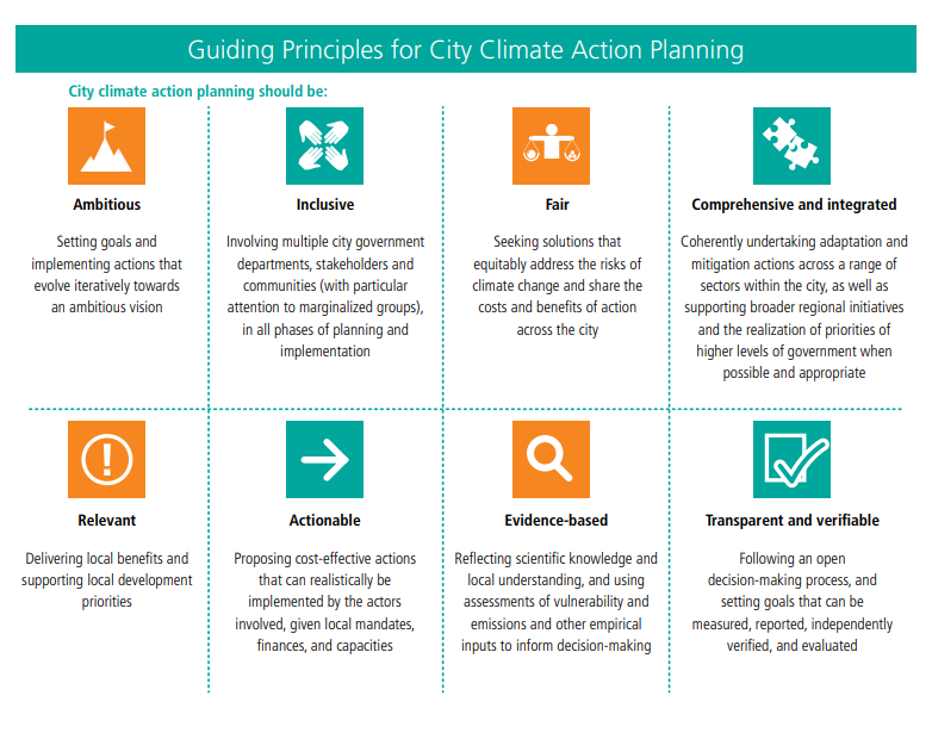
Source: UN-Habitat Guiding Principles for City Climate Action Planning
Core Components of a Strong CAP/CAAP
A strong CAP/CAAP is more than a list of aspirational projects. It’s a plan that connects baseline measurements, actionable strategies, and measurable progress over time. Essential components shared by the most successful plans include:
- GHG Inventory: A comprehensive community-wide Greenhouse Gas (GHG) inventory (Scopes 1 and 2) using the GHG Protocol or other commonly accepted GHG calculation methodologies to establish an emissions baseline and identify the community’s largest emission sources.
- Climate-related Targets: Clear, time-bound decarbonization and other climate-related targets that can be measured and tracked over time (including interim milestones), aligned with science-based pathways and relevant state or national climate commitments. Targets help prioritize actions, track progress, and attract funding and investment.
- Sector-specific mitigation strategies: Actionable steps for each sector to meet targets (such as energy, buildings, transportation, materials, waste, and land use), prioritized based on the community’s most significant emission sources. Each strategy usually includes estimated GHG reductions, cost implications, and co-benefits, such as air quality, job creation, etc.
- Equity and Environmental Justice Integration: A clear explanation of how the plan prioritizes communities that are disproportionately affected by climate change, including how equity is reflected in investments, program design, and access to benefits, such as cost savings and mobility.
- Governance and collaboration: Well-defined departmental ownership, coordinated decision-making frameworks, and identified key partners necessary for effective plan implementation. Defined ownership and coordination help ensure actions move forward, foster alignment across departments and partners, and facilitate funding, implementation, and sustained progress.
- Funding and implementation plan: A realistic assessment of costs, departmental roles and responsibilities, key partnerships, budgeting considerations and funding sources (including grants), and a phased timeline with near-term priorities.
- Monitoring, reporting, and scheduled review: A performance-tracking approach that specifies key indicators, assigns data owners, and establishes a public reporting schedule, along with a regular review and update cycle to ensure the plan continues to be relevant. Ongoing tracking and transparent reporting demonstrate what is effective, reinforce accountability, and allow the plan to adapt as new data emerges, circumstances shift, and community priorities change.
Originally, many cities focused primarily on emissions reduction. As physical climate risks intensify, adaptation is unavoidable. A CAAP includes everything in a CAP, plus structured climate risk and resilience planning. CAAPs reflect a shift from carbon management to comprehensive climate risk management:
- Climate Hazard Assessment: An analysis of the physical climate threats that could impact the community. Climate-related hazards, such as wildfire, drought, heat waves, and other physical impacts, are identified and evaluated for likelihood and impact across different timescales and emissions scenarios, establishing a foundation for resilience planning.
- Climate Vulnerability Assessment: An analysis of community vulnerability to climate hazards, including exposure, sensitivity, and adaptive capacity across people, assets, and essential services. Methods often include overlaying hazards with community assets in GIS, creating an inventory of critical infrastructure, conducting socioeconomic sensitivity analyses, reviewing emergency preparedness capacity, and assessing local resources and capacity to inform adaptation actions.
- Risk Prioritization: A translation of the findings from hazard and vulnerability assessments to identifying and assessing climate-related risks based on the likelihood of their occurrence and the magnitude of the impact. This step helps integrate climate risk into existing risk-management and capital-planning processes.
- Adaptation and Resilience Strategies: Measures intended to reduce material climate risks through adaptation and resilience efforts and uphold essential community services. Examples include stormwater and drainage upgrades, floodplain management, nature-based solutions, and heat mitigation. Strong CAAPs tie each strategy to clear responsibilities, timelines, funding, and outcome tracking, so resilience actions are feasible and practical.
- Governance and Integration: Clear ownership and cross-department coordination that embed climate risk into capital planning, emergency preparedness, operations, and reporting, ensuring resilience actions are ongoing.
- Community Engagement: An overview of stakeholder participation throughout the planning and implementation process, and how feedback shaped priorities, strategies, and tracking. This typically involves departments, elected leadership, community members (especially impacted groups), NGOs, and local businesses to improve practicality, equity results, and community support.
- Financing Strategy: A multi-year funding and capital-planning approach that identifies realistic financing pathways for priority actions. This often includes grouping projects to highlight co-benefits, using findings from climate hazard and vulnerability assessments to strengthen grant applications, and considering options such as bonds, utility partnerships, resilience funds, and phased budgeting.
Collectively, these elements establish a plan that can be implemented, financed, and monitored effectively over time. How these elements are developed and implemented differ across municipalities.
How to Build and Update a CAP/CAAP Over Time
Whether a community is drafting its first CAP or updating an existing one to include adaptation, the planning cycle is similar. Communities generally start by establishing or updating a baseline, such as a greenhouse gas inventory, reduction targets, and, for CAAPs, a vulnerability profile. Next, they translate key priorities into sector-specific actions and formalize the governance, funding, and monitoring systems needed to implement and track progress. The primary focus of these plans evolves. Initial versions often concentrate on reducing emissions, while subsequent updates place greater emphasis on addressing climate risk, vulnerability, and resilience to help ensure essential community services continue without interruption.
The examples below compare two similarly sized fictional municipalities at different stages of maturity. One is developing its first CAP, while the other is updating its CAP to a CAAP to plan and implement adaptation and resilience actions. By comparing their approaches, we can highlight how the process adapts to each community’s needs and circumstances.

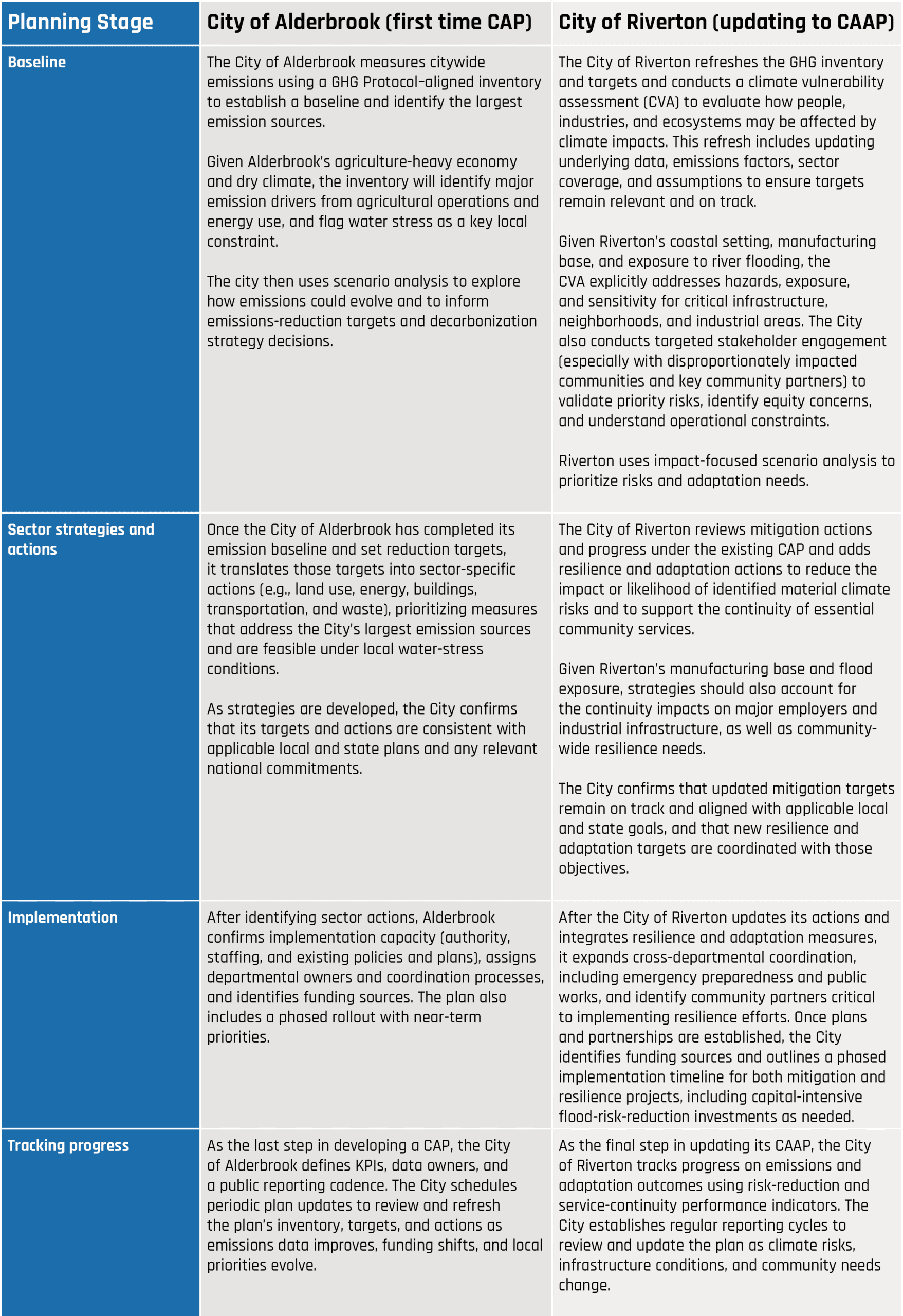
Both cities use the same planning cycle; however, the City of Riverton’s maturity changes the depth and integration of risk and resilience. The most important common aspect of the CAP and CAAP examples above is the review-and-refresh cycle. Plans should be updated regularly as inventories improve, risks are reassessed and reprioritized, funding shifts, and community priorities evolve.
Alderbrook and Riverton are illustrative examples, but the transition from CAPs to more integrated climate-and-resilience planning is already happening in many cities. Below are a few examples showing how California cities have integrated adaptation and resilience into their climate planning.
City of Santa Monica:
 The City of Santa Monica created a short-term CAP, the “15X15” plan, in 2013, designed around a near-term target of reducing GHG emissions by 15% by 2015. Sector-specific targets were established across energy use and generation, waste reduction and recycling, transportation and mobility, open space and land use, water conservation and efficiency, local food and agriculture, and municipal operations. The plan focused on practical mitigation actions to meet near-term GHG reduction goals.
In 2019, Santa Monica adopted a Climate Action and Adaptation Plan (CAAP) that expanded the city’s work from near-term mitigation to a longer-term strategy with deeper emissions cuts and a formal adaptation framework. The CAAP set more ambitious targets, including carbon neutrality by 2050, and organized mitigation actions around key sectors (buildings, waste, and mobility) while adding dedicated resilience strategies focused on community preparedness, water, coastal flooding, and ecosystems.
City of Sacramento:
 Sacramento’s early climate planning centered on a community-wide Climate Action Plan that set near-term emissions-reduction goals and embedded climate policies into long-term strategic planning. The City adopted a CAP in 2012 with a 2020 emissions target and then incorporated an updated community CAP into the 2035 General Plan when it was adopted in 2015. Sacramento’s General Plan is the City’s long-term policy blueprint for growth and investment, guiding land use, infrastructure, and related programs.
In 2024, Sacramento adopted a CAAP alongside its 2040 General Plan. The CAAP expanded climate efforts from primarily mitigation planning to a more integrated framework of mitigation and adaptation. The CAAP sets updated climate targets (including a 2030 per-capita emissions target and a net-zero goal) and is explicitly framed to both reduce emissions and address climate impacts through adaptation planning.
City of Irvine:
 The City of Irvine took a different approach to bolstering its climate action planning. Rather than updating an existing CAP, the City began by setting its direction through a citywide climate resolution called Irvine ACHIEVES, a policy statement that outlined key strategies, established a 2030 carbon-neutrality target, and launched a planning process to develop a comprehensive CAAP.
Through the CAAP process, the City engaged the community to set priorities, developed a GHG inventory and targets, and conducted a vulnerability assessment to guide adaptation planning. This resulted in an integrated plan covering both emissions reduction and climate risk.
These real-world examples mirror those of Alderbrook and Riverton. Early plans often begin with mitigation fundamentals, and later updates strengthen the work by adding vulnerability assessments, adaptation measures, and more robust implementation systems. Cities may call these documents different things (CAP, CAAP, Climate Action & Resilience Plan), but the evolution of these plans is similar: over time, municipalities develop clearer accountability, a stronger link between risk and investment, and greater integration across departments and planning procedures.
Conclusion
Effective climate planning is a continuous process, not a one-time achievement. Success depends less on the specific label, CAP or CAAP, and more on whether the plan remains practical and adaptable over time. The Alderbrook and Riverton examples show how plans can evolve to reflect changing conditions, expanding capacity and scope as needed. Early plans typically focus on organizing emissions data, setting clear targets, and implementing sector actions within available resources. As plans mature, they integrate detailed risk assessments and scenario planning to inform resilience and adaptation investments and safeguard essential community services. Treating the plan as an ongoing management tool, supported by routine updates, transparent reporting, and active stakeholder engagement, ensures it remains relevant and effective as local needs and priorities shift.
For communities just beginning this process, the priority should be to establish a solid baseline and identify a manageable set of initial actions. For those with more experience, efforts should focus on bolstering accountability, updating targets, and integrating resilience to align the plan with evolving risks and realities.
If your city is building a Climate Action Plan or updating a Climate Action and Adaptation Plan, we can help with the technical analysis, stakeholder process, and implementation roadmap needed to turn climate goals into feasible and managed action plans. At GSI, our experts help support municipalities with CAPs and CAAPs through the following services:
- Calculating community-wide GHG inventories and helping develop realistic, but ambitious goals
- Conducting comprehensive climate hazard, vulnerability, risk, and scenario analysis assessments
- Assisting in strategy development for mitigation, adaptation, and resilience actions established in the plan
- Facilitating stakeholder engagement and establishing clear governance structures, supported by effective monitoring and reporting systems
- Evaluating the financial implications of climate risks and community needs to inform funding strategies