A new publication examines how microbial processes may influence the fate of CO2 in geologic carbon sequestration settings. The article, Biotransformation Processes...
A new publication examines how microbial processes may influence the fate of CO2 in geologic carbon sequestration settings.
The article, Biotransformation Processes Relevant to Geologic Carbon Sequestration: Potential Implications for Environmental Fate, is published in Environmental Science & Technology and is authored by GSI experts Lisa J. Molofsky, Thomas E. McHugh, Danny Kingham, and Charles J. Newell, with contributions from Sven Lahme, Kelly M. McFarlin, Paul G. Koster van Groos, Frank E. Löffler, Louise Camenzuli, Leanne Walker, Sophie L. Nixon, and Trent A. Key.
The paper reviews how CO2-driven geochemical changes can alter microbial communities and trigger biotransformation processes that move carbon into mineral, gas, or organic phases. It also explores implications for both deep storage formations and nontarget environments such as shallow groundwater, the vadose zone, and marine systems, while identifying key knowledge gaps that affect long-term prediction of CO2 behavior.
Read the full open-access article here:
https://pubs.acs.org/doi/10.1021/acs.est.5c02389
A new article by Ayman Alzraiee and Richard Niswonger has been published in Journal of Hydrology: Regional Studies.
The article, “Assessing future hydrologic extremes using an integrated hydrology and river operations model in the Russian River watershed,” presents an integrated surface water, groundwater, and operations modeling approach to evaluate how climate change and water use may affect streamflow conditions.
The study finds that groundwater pumping can significantly deplete streamflow, streamflow droughts become longer and more severe under climate change scenarios, peak flows increase substantially in wetter futures, and reservoirs play a key role in buffering these impacts across the watershed.
Congratulations to Dr. Gino Bianchi Mosquera, PG, BCES, on the publication of "Facilitated Transport of Organic Contaminants in a High Concentration, Multicomponent Plume," in...
Congratulations to Dr. Gino Bianchi Mosquera, PG, BCES, on the publication of “Facilitated Transport of Organic Contaminants in a High Concentration, Multicomponent Plume,” in Groundwater Monitoring & Remediation.
This open access article, co-authored with D. M. Mackay, B. Myller, B. D. Honeyman, M. Schirmer, R. M. Allen-King, W. P. Ball and R. L. Stollar, presents findings from a field experiment at the Rocky Mountain Arsenal evaluating organic contaminant transport within a complex plume. The study provides new insight into why contaminants may migrate with little to no sorptive retardation in situ and identifies the need for additional laboratory research to better understand the plume components that influence sorption and mobility.
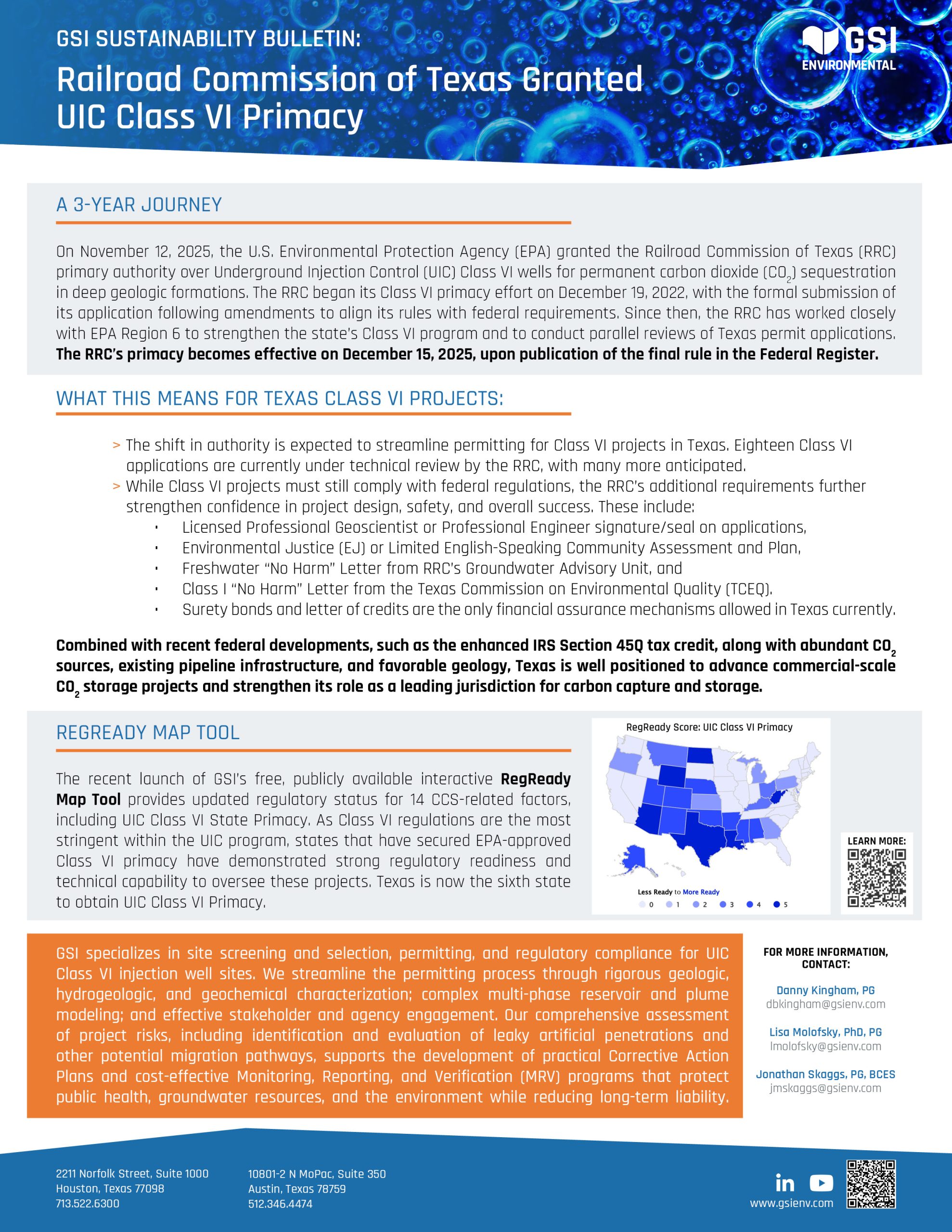
Big News for Texas Carbon Capture and Storage (CCS) Projects: The EPA has officially granted the Railroad Commission of Texas (RRC) UIC Class VI primacy, giving the state primary authority over Class VI CO₂ injection wells starting December 15, 2025.
Why this Matters: Texas CCS developers can expect more streamlined UIC Class VI permitting and effective stakeholder and agency engagement. With 18 applications already under review, and many more coming, this shift is a major step toward accelerating commercial-scale CO₂ storage projects across the state.
Combined with enhanced federal IRS 45Q tax credits, suitable geology, and existing infrastructure, Texas is now positioned as one of the most competitive jurisdictions in the U.S. for CCS development.
GSI has supported UIC Class VI projects nationwide with:
✔ Site screening and geologic/hydrogeologic characterization
✔ Class VI permit preparation and regulator-ready submittals
✔ Multi-phase reservoir modeling
✔ Practical and cost-effective testing and monitoring plan design and implementation
✔ Stakeholder and agency engagement
✔ Detailed artificial penetration review and Corrective Action Plan design
✔ Water resource assessments
✔ Alignment with IRS 45Q, LCFS, and EPA GHG reporting requirements
We support clients with strong, regulator-ready applications that keep projects moving efficiently from feasibility through permitting and operation. Reach out to learn how GSI can support your Class VI project.
Lisa Molofsky, PhD, PG has co-authored a new article titled "A combined 228Ra/226Ra and 87Sr/86Sr approach to identify the production of out-of-zone formation...
Lisa Molofsky, PhD, PG has co-authored a new article titled “A combined 228Ra/226Ra and 87Sr/86Sr approach to identify the production of out-of-zone formation fluid from Marcellus shale gas wells,” published in Applied Geochemistry.
This article, co-authored with M.A. Engle, T.W. Wagner, A.S. Wylie, and D.P. Fernandez, presents a geochemical method that combines radium and strontium isotope ratios to determine the origin of high-salinity fluids produced from Marcellus shale gas wells. The study provides valuable insights into identifying out-of-zone water production and offers a framework that could be applied to other oil and gas basins.