Climate resilience requires more than identifying and disclosing risk. It requires connecting climate information to decisions about facilities, infrastructure, water, supply chains,...
Climate resilience requires more than identifying and disclosing risk. It requires connecting climate information to decisions about facilities, infrastructure, water, supply chains, capital investment, and long-term strategy.
It’s this connection between climate insight and real-world decision-making that GSI explores in the latest Climate Change Business Journal Adaptation & Resilience issue from Environmental Business International, Inc.
In the article, “GSI Environmental Connects Sustainability Strategy With Applied Environmental Science and Engineering,” Principal Scientist Becky Twohey, PhD, discusses how climate consulting is evolving from a primarily disclosure-focused exercise into multidisciplinary business decision support.
The interview explores:
How climate scenario analysis can inform siting, design, and capital allocation
• Why engineers, hydrologists, geologists, operators, and finance teams are essential to credible climate planning
• How enterprise risk management can help move organizations from analysis to implementation
• Why climate data fitness, governance, and transparency matter as much as data availability
• How companies can use uncertainty to preserve flexibility and strengthen long-term competitiveness
GSI’s Sustainability and Climate group combines strategic climate expertise with applied environmental science and engineering to help clients move from identifying risks to making practical, defensible decisions.
Read the feature: https://www.gsienv.com/gsi-environmental-connects-sustainability-strategy-with-applied-environmental-science-and-engineering/
Scope 1 and Scope 2 emissions reports under California’s Climate Corporate Data Accountability Act (SB 253) are due November 10, 2026. CARB has now issued the guidance, filing options, and intake tools companies need to determine whether they must report and how to submit for the first reporting cycle.
Below is a brief outline of everything preparers need to know in order to meet upcoming compliance deadlines, including CARB’s most significant update on September 1 containing the resources companies need to file for 2026.
Who Must Report Under California SB 253 in 2026?
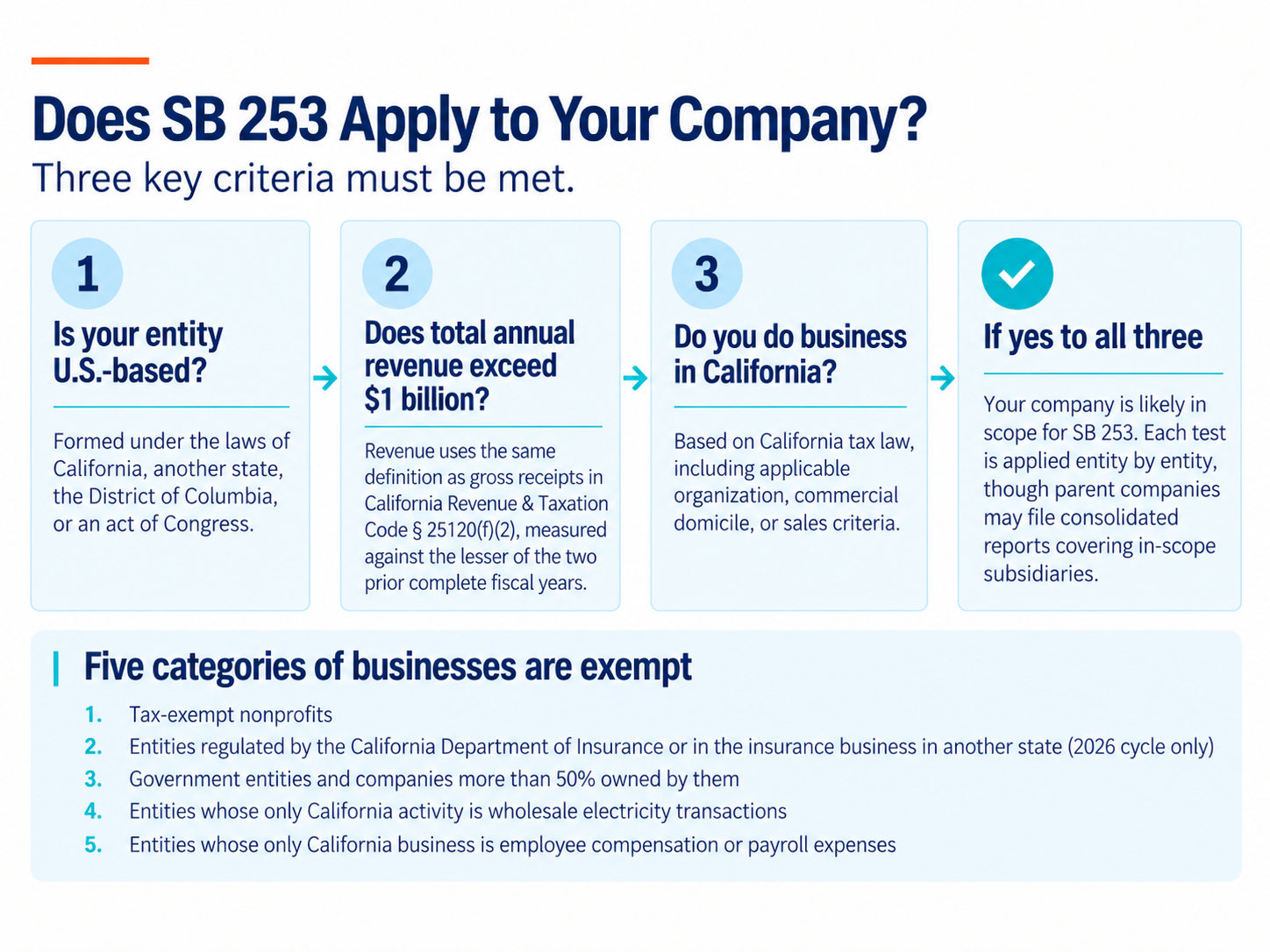
Companies are in scope for California’s corporate GHG reporting requirements if they meet all three criteria below:
The entity must be U.S.-based (formed under the laws of California, another state, the District of Columbia, or an act of Congress).
It must have total annual revenue above $1 billion, with “revenue” using the same definition as gross receipts in California Revenue & Taxation Code § 25120(f)(2) and applicability measured against the lesser of the entity’s two prior complete fiscal years.
It must be doing business in California under existing tax law (defined as California sales of at least $735,019 or 25% of total sales)
Each test is applied entity by entity, though parent companies may file consolidated reports covering in-scope subsidiaries (fees are still assessed individually).
Five categories of business are considered exempt: (1) tax-exempt non-profits; (2) entities regulated by the California Department of Insurance or in the insurance business in any other state; (3) government entities and companies majority-owned (more than 50%) by them; (4) entities whose only California activity is wholesale electricity transactions; and (5) entities whose only California business is employee compensation or payroll expenses, including teleworking employees.
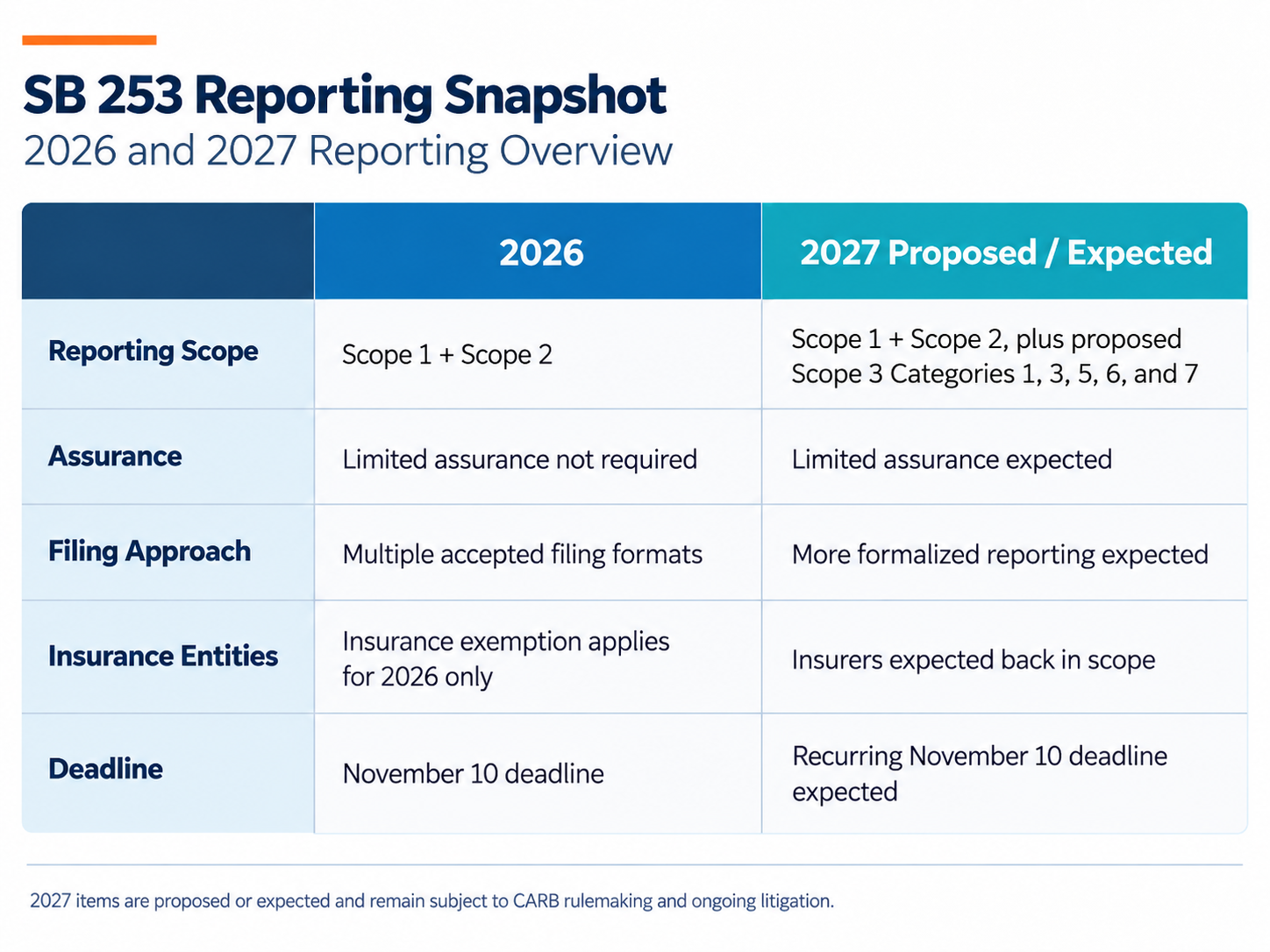
Note that the insurance exclusion at this time applies to the 2026 cycle only. As of July 21, CARB has determined that the existing Department of Insurance reporting does not satisfy SB 253 and has proposed removing the reporting exemption beginning in 2027. For now, insurers should assume they will need to report.
Do All Companies in Scope Have to Submit GHG Emissions Data in 2026?
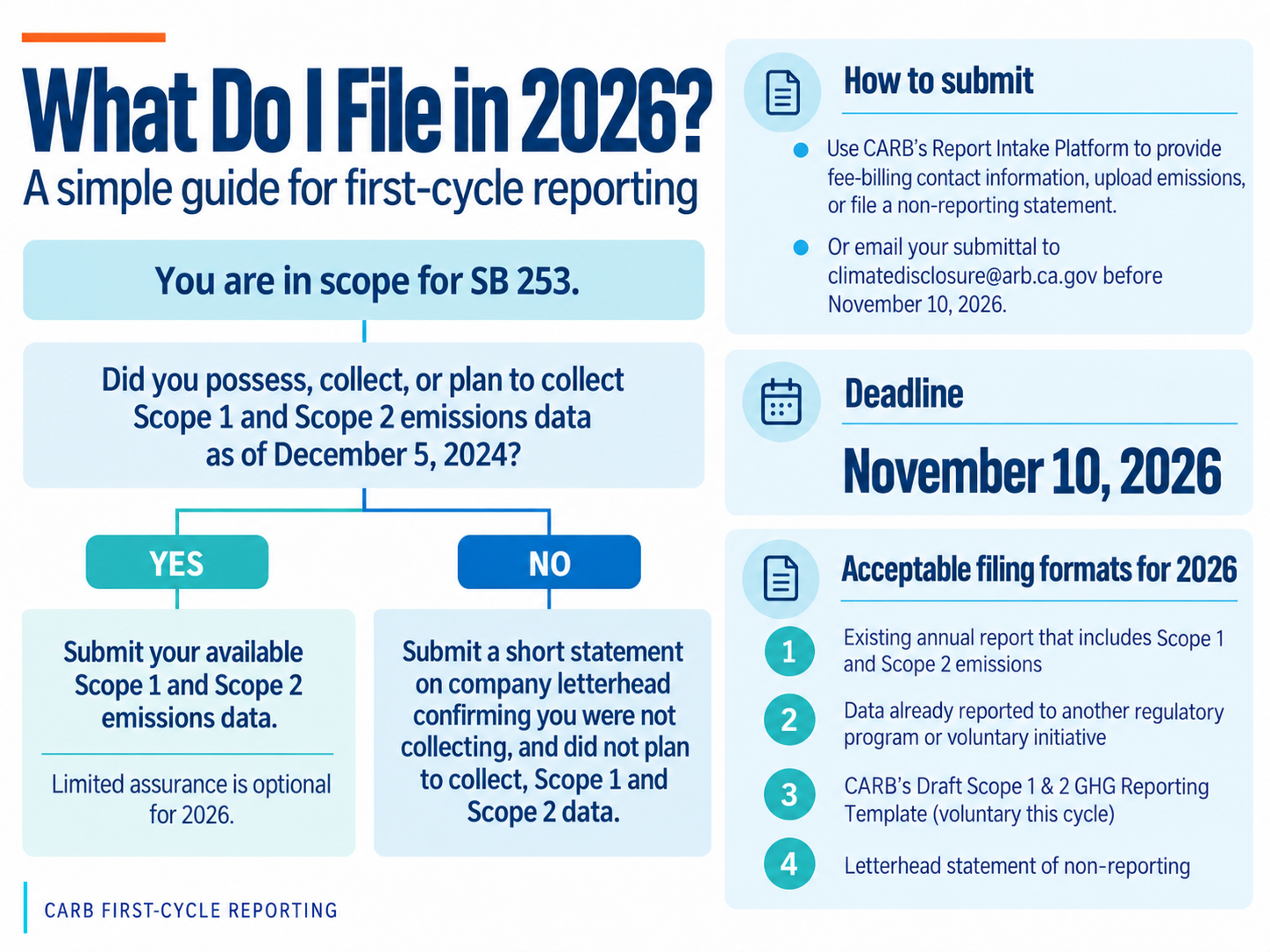
Being in scope does not necessarily mean submitting emissions this year. Under CARB’s December 5, 2024 Enforcement Notice, first-year reporters may submit Scope 1 and Scope 2 emissions based only on information they already possessed or were already collecting as of December 5, 2024, with or without assurance. Entities that were neither collecting that data nor planning to collect it as of December 5, 2024, are not expected to submit emissions data at all for the 2026 cycle.
Not collecting data does not exempt an entity from filing with CARB. Companies in that position must provide a short statement on company letterhead confirming that they were not collecting, and did not plan to collect, Scope 1 and Scope 2 data when the Notice was issued.
This statement can be filed through the intake platform or emailed to CARB before November 10, 2026.
How Do Companies Submit SB 253 Reports to CARB in 2026?
On September 1, CARB released its most directive guidance to date regarding how preparers should submit their filing to CARB for 2026. As part of that release, the Report Intake Platform was made public, which entities can use to provide fee-billing contact information, upload emissions, or file a non-reporting statement. Note that submittals may also be emailed directly to climatedisclosure@arb.ca.gov.
Four formats are acceptable this year: an existing annual report that already includes Scope 1 and Scope 2 emissions, data already reported to another regulatory program or voluntary initiative, CARB’s Draft Scope 1 & 2 GHG Reporting Template (posted October 10, 2025 and voluntary this cycle), or the letterhead statement of non-reporting described above.
CARB clarified that no specific emission factor dataset is required for 2026: because U.S. EPA has not released eGRID 2024 on its usual timeline, CARB will accept eGRID 2023, the eGRID 2024 dataset published by the Cornerstone Sustainability Data Initiative, or another credible source, so long as the factors and their sources are identified.
Additionally, CARB will accept submittals regardless of whether limited assurance was obtained.
What Will Change for California SB 253 Reporting in 2027?
The 2026 guidance applies only to the first cycle. Everything after is being built through a separate rulemaking, previewed at CARB’s July 21, 2026 workshop, with a draft regulation expected later this year. That being said, CARB has provided stakeholders an idea of what to expect for the upcoming year.
In addition to Scope 1 and 2 emissions reporting, CARB has proposed requiring the five most commonly reported Scope 3 categories beginning in 2027: purchased goods and services, fuel- and energy-related activities, waste generated in operations, business travel, and employee commuting (Categories 1, 3, 5, 6, and 7, respectively). The other 10 would remain voluntary.
Limited assurance is expected to shift from voluntary to mandatory, with reports submitted in 2027 requiring third-party assurance of Scope 1 and Scope 2 emissions under an approved standard.
Beyond that, expect a recurring November 10 deadline, close alignment with the GHG Protocol Corporate Standard, Scope 2 Guidance, and Scope 3 Standard, deliberate interoperability with IFRS S2 and the EU CSRD, and Scope 2 disclosure under both market-based and location-based methods.
As mentioned above, insurance companies are expected to come back into scope starting next year, with CARB proposing that they satisfy both CARB and Department of Insurance requirements through a single report, supplemented as needed to cover Scope 3 and assurance.
Note that all of these updates are contingent on a favorable outcome on the existing Ninth Circuit litigation that is continuing in the background. Until the courts rule otherwise, SB 253 is still in effect, and companies should plan on reporting.
How GSI Environmental Supports SB 253 and California GHG Reporting Compliance
GSI Environmental can support clients at each stage of the reporting process, from determining applicability and organizing emissions data to preparing disclosures and planning for assurance. Our multidisciplinary team of engineers, scientists, accountants, and MBAs includes CARB-accredited Lead GHG Verifiers serving clients across real estate, retail, manufacturing, energy, healthcare, technology, and the public sector.
Among many services, our team is equipped to calculate Scope 1, 2, and 3 inventories, develop Inventory Management Plans, and provide limited assurance and verification ahead of the 2027 requirement.
We also support Scope 3 readiness and supply-chain engagement, SB 261 climate risk reporting and scenario analysis, CSRD and CDP disclosure, and decarbonization planning.
California SB 253 and CARB GHG Reporting Resources
For further information about the status of California’s GHG Reporting Program, make sure to explore CARB’s resources page.
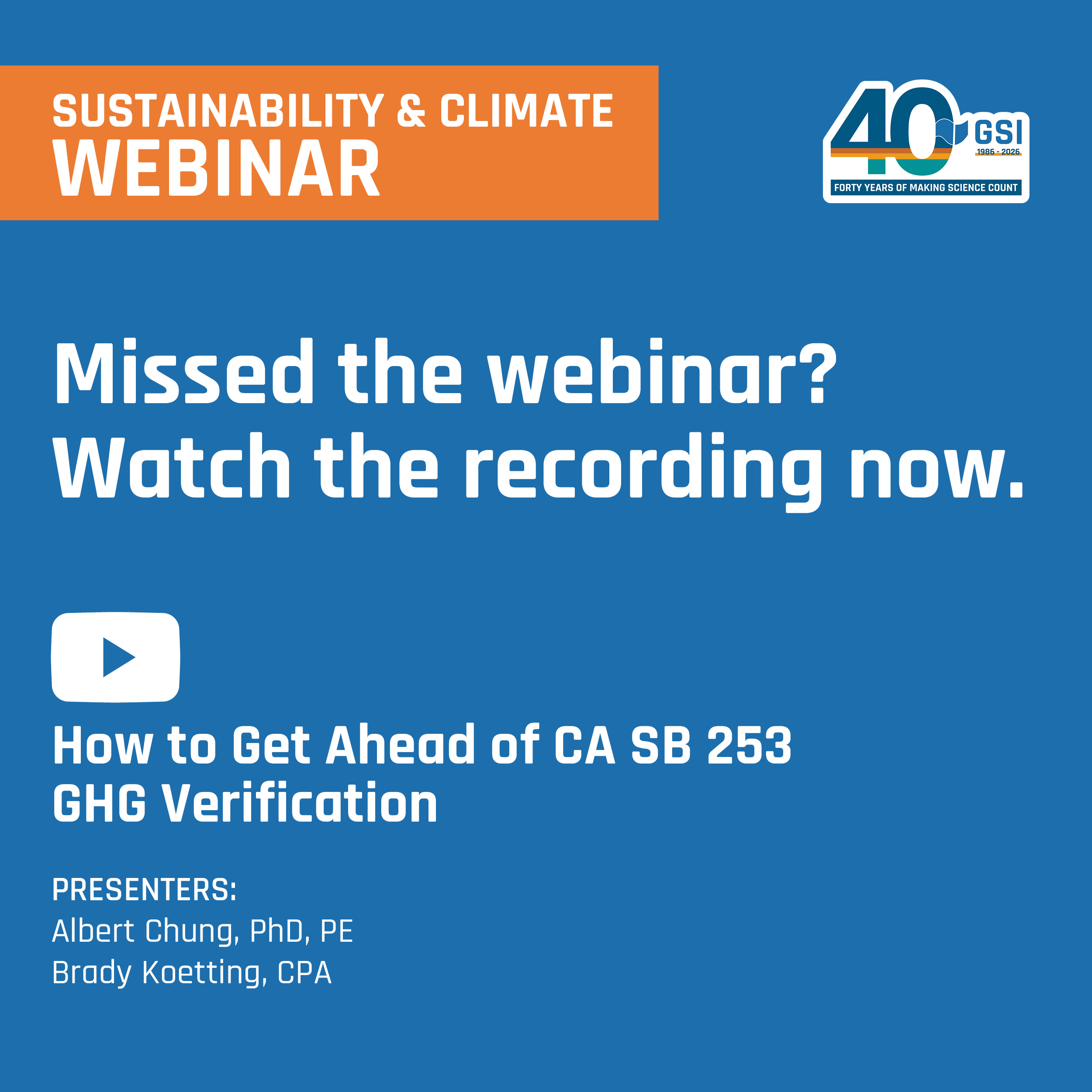
Missed our recent Sustainability & Climate webinar, “How to Get Ahead of CA SB 253 GHG Verification?” You can now watch the full recording on GSI’s YouTube channel.
In this session, Albert Chung, PhD, PE, and Brady Koetting, CPA, discuss what companies should know as SB 253 moves from reporting preparation toward verification, assurance, and audit-ready emissions data.
The webinar covers the current state of SB 253, what to expect from the verification process, common assurance questions, supporting documentation, materiality, internal controls, site visits, and steps organizations can take now to identify gaps before assurance begins.
Please note that regulatory guidance has continued to evolve since this webinar was recorded. Since the webinar, the California Air Resources Board (CARB) announced a proposed update that would defer the initial Scope 1 and Scope 2 greenhouse gas reporting deadline from August 10, 2026, to November 10, 2026. This proposed three-month extension is intended to provide additional clarity following final approval of the regulation. The general guidance shared in this webinar on how companies can prepare remains applicable, including the importance of organizing data, confirming reporting boundaries, engaging internal stakeholders, and preparing for verification.
Keep an eye out for more upcoming webinars from GSI as we continue sharing insights on sustainability, climate disclosure, regulatory changes, and environmental strategy.
As climate reporting shifts from voluntary pledges to mandatory disclosure, companies are increasingly combining science-based targets, net zero management systems, and regulatory...
As climate reporting shifts from voluntary pledges to mandatory disclosure, companies are increasingly combining science-based targets, net zero management systems, and regulatory reporting frameworks to demonstrate both ambition and execution. Rather than operating as standalone initiatives, frameworks such as ISO 14060, SBTi, IFRS S2, and ESRS can be viewed as complementary components of an emerging three-layer Climate Accountability Stack, connecting implementation, credibility, and disclosure to help organizations move from climate commitments to measurable progress.
The net zero standards landscape is entering a new phase. For years, companies have struggled with a crowded mix of voluntary frameworks, investor expectations, carbon accounting rules, and climate disclosure requirements. Two of the most significant recent developments are the draft ISO Net Zero Aligned Organizations Standard (ISO 14060) and the Science Based Targets initiative’s Corporate Net-Zero Standard Version 2.0. [1][2]
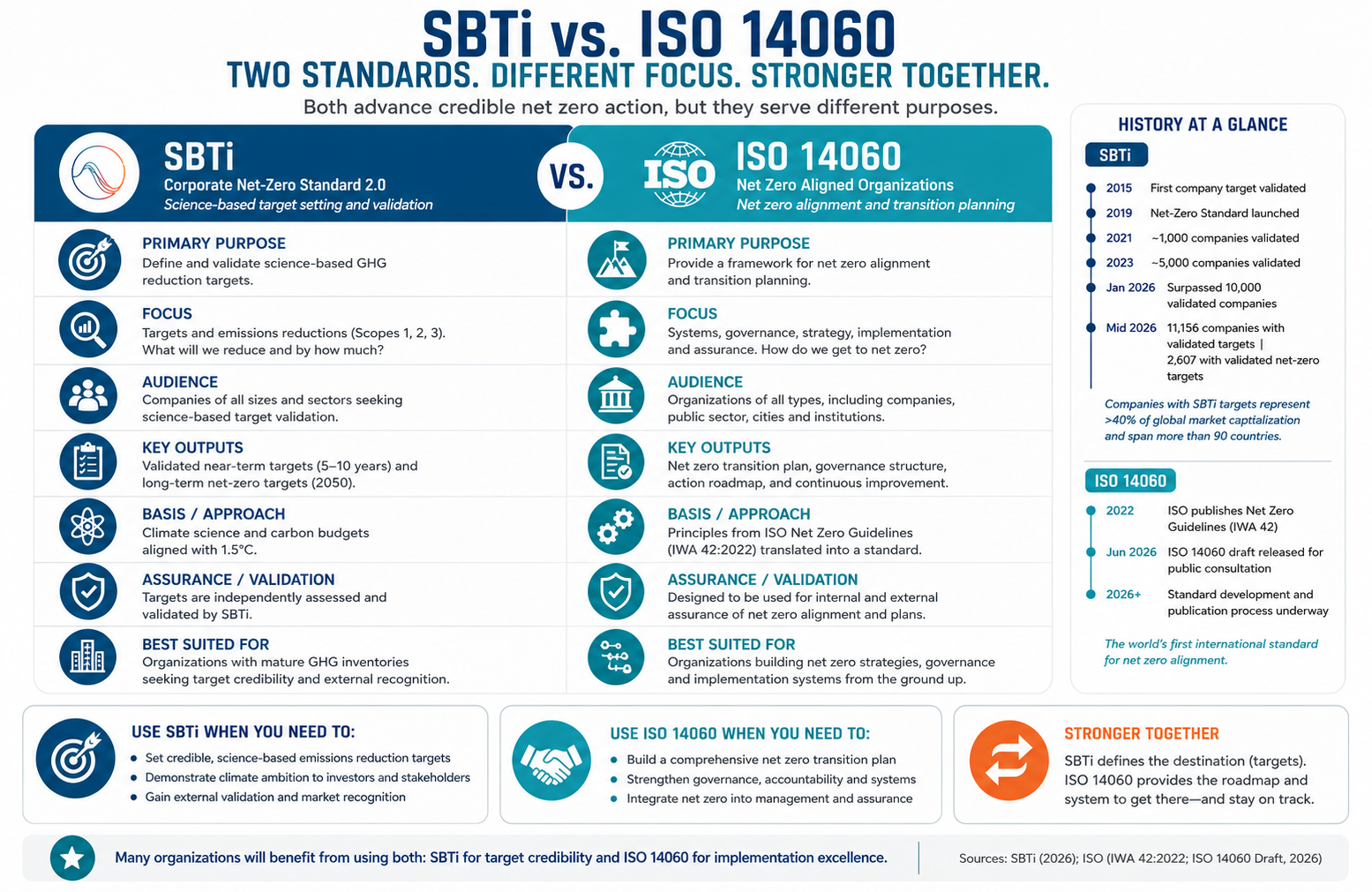
Both aim to improve the credibility of corporate net zero claims. But they are not interchangeable. ISO 14060 is emerging as a broad, internationally harmonized standard for net zero transition planning and alignment, while SBTi remains a more prescriptive target-setting and validation framework focused on emissions reductions aligned with climate science. [3][4]
A Brief History of the ISO Net Zero Standard
ISO’s work on net zero began with the ISO Net Zero Guidelines, IWA 42:2022, launched at COP27. The guidelines were developed to create a common global reference point for what “good” net-zero action should look like across organizations, cities, regions, and countries. ISO describes IWA 42 as a framework intended to align territorial approaches, such as national or city net zero plans, with organizational and value chain approaches. [2]
The draft ISO 14060 standard builds on those 2022 guidelines. ISO released the draft for public consultation June 2026, describing it as the world’s first international standard for net zero alignment and a tool to support credible, comprehensive net-zero transition plans. [1] Public consultation ends in August 2026 and the final publication is expected in 2027.
The significance of ISO 14060 is that it moves net zero from guidance toward a more formal, potentially certifiable and independently verifiable management-system-based standard. That matters because ISO standards are already widely used by companies for environmental management, quality, safety, and risk systems. For companies that already use ISO 14001 or other ISO management systems, ISO 14060 may be easier to integrate into existing governance, controls, documentation, and assurance processes.
A Brief History of SBTi’s Corporate Net-Zero Standard
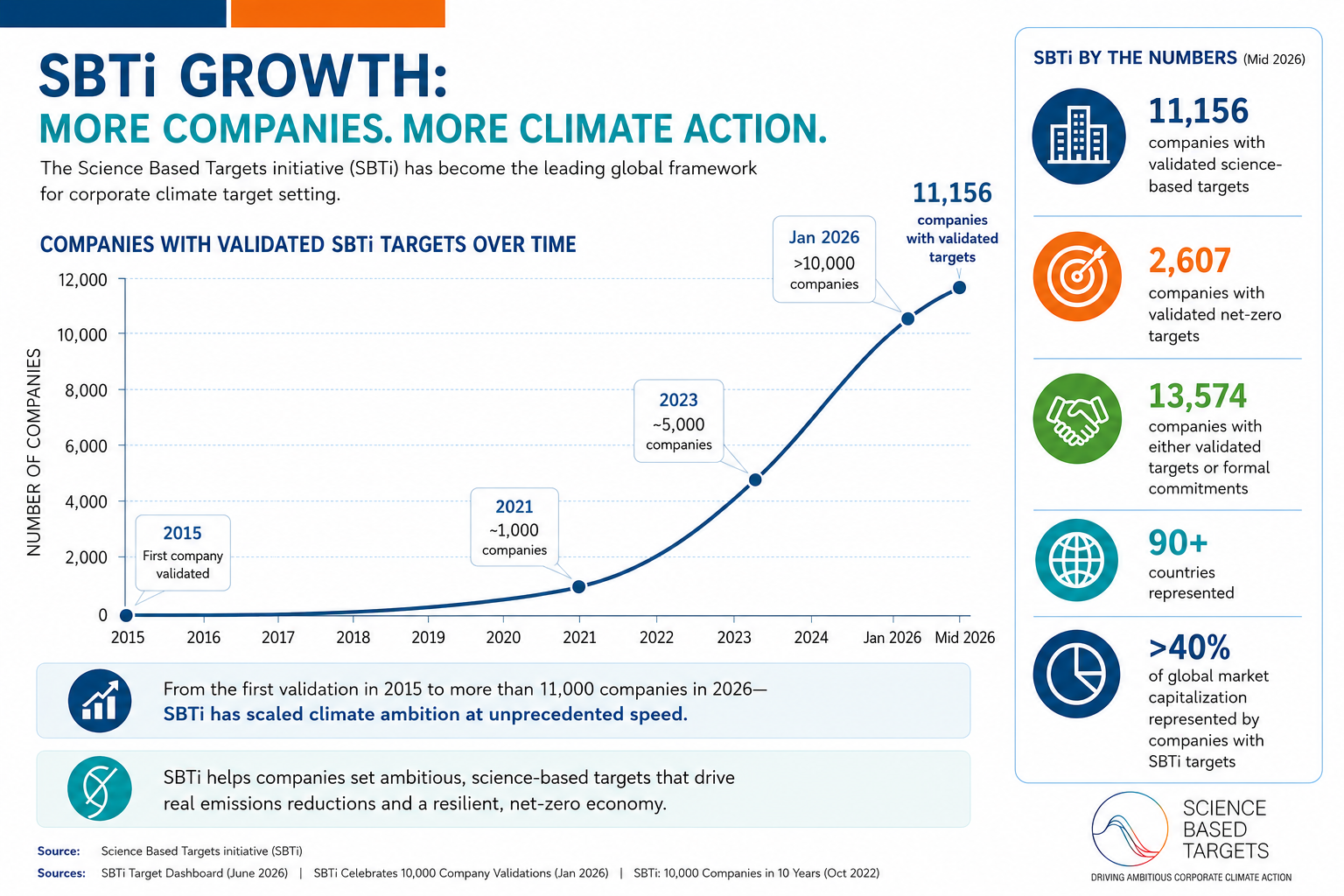
The Science-Based Targets initiative was launched before the Paris Agreement and has become one of the most influential voluntary frameworks for corporate emissions target setting. Its Corporate Net-Zero Standard gave companies a science-based pathway for setting near-term and long-term emissions reduction targets, with an emphasis on deep value chain decarbonization before neutralizing residual emissions.
SBTi’s Corporate Net-Zero Standard Version 2.0 was developed through a multi-year revision process. According to SBTi, the Version 2.0 revision process included two public consultations and extensive pilot testing involving 1,800 stakeholders, with more than 320 companies participating in the first phase of pilot testing and more than 50 in the second. [4] Version 2.0 was released this month (June 2026) and is described by SBTi as its most comprehensive framework for corporate climate action to date. [3] Validation against the new standard is expected to open in early 2027.
Where ISO 14060 and SBTi’s Corporate Net-Zero Standard 2.0 are Similar
ISO 14060 and SBTi’s Corporate Net-Zero Standard 2.0 share several important principles. Both are designed to increase credibility in corporate net-zero claims by:
Emphasizing the need for near-term action rather than distant 2050 commitments.
Recognizing that organizations need accountability, implementation standardization, actionable emissions measurement, transparency, and progress reporting.
Both also respond to the same underlying problem:
Corporate net zero claims have often been inconsistent, poorly defined, overly reliant on offsets, or disconnected from real operational decisions.
In that sense, both standards are part of a broader movement away from aspirational climate commitments and toward evidence-based transition planning.
Where ISO 14060 and SBTi’s Corporate Net-Zero Standard 2.0 Differ
The biggest difference is purpose. SBTi is primarily a target-setting and validation framework. It is best known for defining whether a company’s greenhouse gas reduction targets are aligned with climate science. It is especially relevant for companies that want externally validated emissions reduction targets that investors, customers, and disclosure users recognize.
ISO 14060 is broader. It is focused on net zero alignment and transition planning, not only target validation. It may be better understood as a management-system-oriented standard that helps organizations structure their net zero strategy, governance, implementation, and assurance approach.
Another major difference is audience. SBTi is designed primarily for companies. ISO’s net zero work is intended to be useful across organizations, policymakers, cities, regions, and other institutions. ISO’s 2022 guidelines explicitly aimed to align territorial and value chain approaches. [2]
There is also a difference in how each establishes credibility. SBTi validates targets. ISO standards, depending on the final structure and assurance ecosystem, may be used more like other ISO standards: as a basis for internal controls, third-party assessment, and integration with management systems.
When SBTi May Be the Better Fit
SBTi may be the better choice for a company seeking recognition by investors, customers, employees, and rating organizations. It is particularly useful for companies facing pressure from large customers, lenders, or sustainability ratings platforms to demonstrate that their Scope 1, 2, and 3 targets are aligned with climate science.
SBTi is also likely to remain the stronger option when the primary need is emissions target credibility. For companies with mature greenhouse gas inventories, strong Scope 3 data, and a desire to make public climate commitments, SBTi provides a structured pathway for setting and validating targets.
When ISO 14060 May Be the Better Fit
ISO 14060 may be more suitable for organizations that need a practical net-zero management framework rather than only a validated target. This may include companies that are earlier in their climate journey, organizations with complex operations, public agencies, infrastructure companies, private companies, or companies already using ISO 14001 or other ISO management systems.
ISO 14060 may also be useful where the challenge is not only “what should our target be?” but “how do we build the governance, controls, transition plan, documentation, and accountability needed to deliver it?”
For companies preparing climate transition plans under regulatory or investor pressure, ISO 14060 could become a practical bridge between climate strategy, enterprise risk management, environmental management systems, and disclosure readiness.
Why Companies May Need Both ISO 14060 and SBTi
For many years, net zero commitments were largely voluntary. Companies adopted science-based targets, published sustainability reports, and announced ambitious climate goals in response to investor expectations, customer pressure, and corporate values. Today, however, climate commitments are increasingly intersecting with mandatory disclosure requirements.
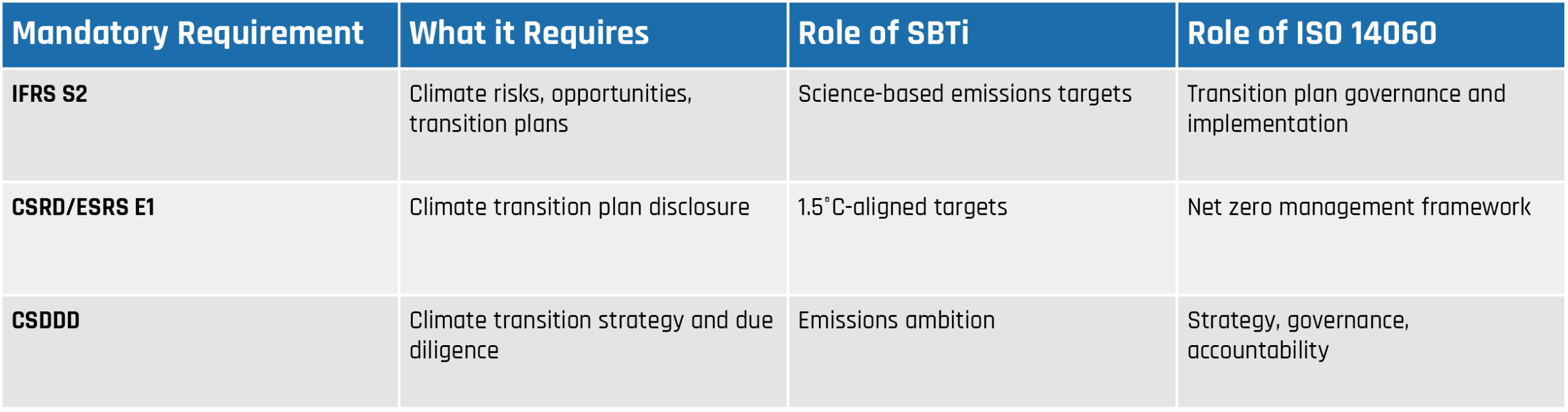
Frameworks such as the International Sustainability Standards Board’s (ISSB) IFRS S2 Climate-related Disclosures and the European Union’s Corporate Sustainability Reporting Directive (CSRD), implemented through the European Sustainability Reporting Standards (ESRS), require companies to disclose not only their greenhouse gas emissions and targets, but also the governance, strategy, risks, transition plans, and resources supporting those commitments. [5]
This shift raises an important question: How can companies demonstrate that their net zero ambitions are credible, actionable, and embedded within business operations?
The answer may lie in combining the strengths of SBTi and ISO 14060. SBTi provides external credibility for emissions reduction targets. It establishes whether a company’s near-term and long-term greenhouse gas reduction goals are aligned with climate science and SBTi’s applicable target-setting methodologies. Investors, customers, and rating organizations increasingly recognize SBTi validation as a benchmark for ambition and target credibility. [3]
ISO 14060 addresses a different challenge. It provides a framework for developing and maintaining the systems required to achieve those targets. This includes governance structures, organizational accountability, transition planning, implementation processes, monitoring, and continual improvement. In essence, ISO 14060 may provide the operational architecture behind a company’s net zero strategy.
While SBTi and ISO 14060 were developed as voluntary frameworks, their importance is growing as climate disclosure requirements become increasingly mandatory. As a result, many organizations are beginning to view these standards not simply as sustainability tools, but as building blocks for regulatory compliance and disclosure readiness.
IFRS S2: Connecting Net Zero Commitments to Investor Disclosures
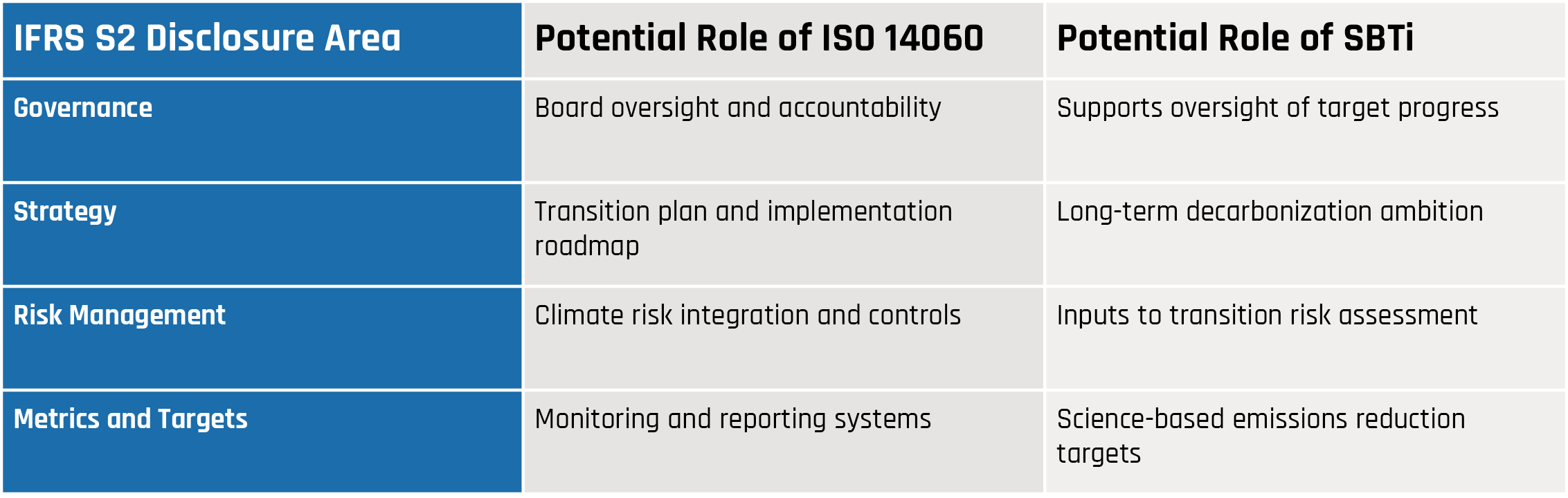
IFRS S2 requires companies to disclose climate-related information across four pillars:
Governance
Strategy
Risk Management
Metrics and Targets
ISO 14060 could provide the supporting management system for these disclosures, while SBTi provides the validated targets disclosed under the Metrics and Targets pillar. [5]
A company may therefore disclose:
“Our net zero transition plan is developed in accordance with ISO 14060 principles for Net Zero Aligned Organizations, and our greenhouse gas reduction targets have been independently validated by the Science Based Targets initiative.”
ESRS E1: From Climate Commitments to Transition Plans
The European Sustainability Reporting Standards go even further. ESRS E1 requires organizations to disclose [6]:
A climate transition plan
Decarbonization levers and actions
Climate governance
Policies and targets
Capital expenditures aligned with the transition
Progress toward climate goals
ISO 14060 is particularly well aligned with these requirements because its primary focus is establishing the systems, governance, and implementation pathways needed to deliver net zero commitments. Meanwhile, SBTi can provide confidence that the emissions reduction pathway embedded in the transition plan is grounded in climate science.
The Emerging Climate Accountability Stack
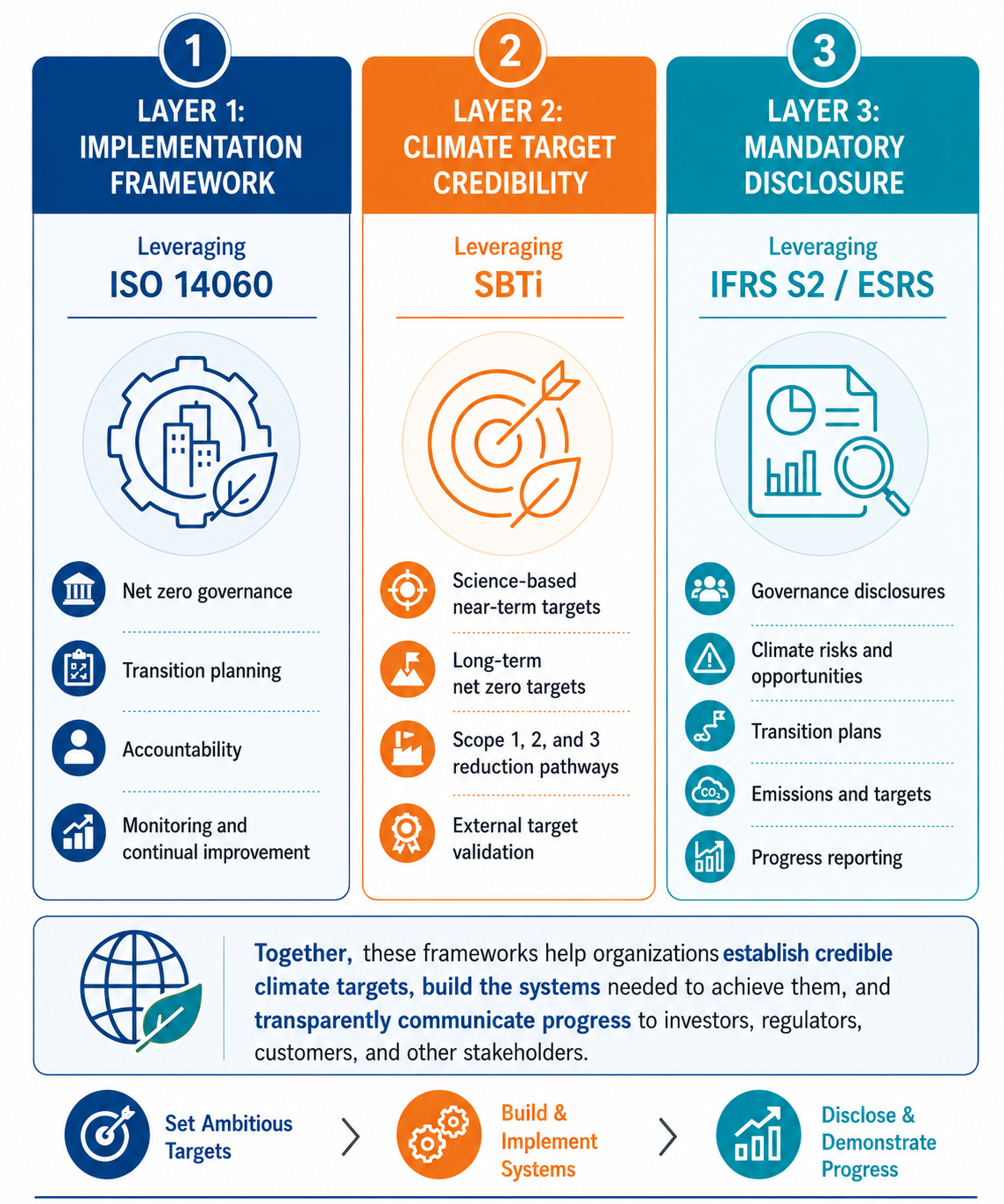
As mandatory reporting expands globally, many organizations may adopt a three-layer approach that helps organizations move from climate ambition to implementation, verification, and transparent disclosure:
Viewed together, these frameworks illustrate how climate management is evolving from a focus on target-setting toward a more integrated model of implementation, validation, and disclosure. SBTi establishes where a company needs to go, and ISO 14060 helps define how it gets there. IFRS S2 and ESRS provide the framework for transparently communicating that journey to investors, regulators, and stakeholders.
As climate reporting evolves from voluntary commitments to mandatory accountability, companies that can integrate all three elements, credible targets, robust implementation systems, and transparent disclosure, may be best positioned to demonstrate both ambition and execution.
SBTi’s influence has also made it a target of criticism. Some critics argue that Version 2.0 introduces too much flexibility and weakens the rigor that made SBTi valuable. Recent reporting has highlighted concerns that the revised standard allows companies to miss targets if they demonstrate “best efforts,” disclose barriers, and provide evidence of action. Critics have also raised concerns about greater flexibility around energy certificates and value chain approaches. [8]
SBTi has also faced scrutiny over governance, corporate influence, and sector-specific standards. Its oil and gas standard was reportedly paused after several major energy companies withdrew from the process, raising questions about how voluntary standards should handle hard-to-abate and fossil-fuel-intensive sectors. [9]
The central criticism is that if SBTi becomes too flexible, it risks losing scientific credibility. If it remains too strict, some companies may disengage. Version 2.0 is an attempt to navigate that tension.
Criticisms of ISO 14060
Because the standard is new and still in consultation [1], it remains to be seen how rigorous, auditable, and widely adopted it will be. ISO standards can be powerful because they are globally recognized, but they can also be broad. If ISO 14060 becomes too process-oriented, it may help companies document net zero plans without necessarily ensuring the level of emissions reductions needed for climate alignment.
Another concern is that companies may use ISO alignment as a credibility signal without pursuing SBTi-level emissions reduction ambition. The effectiveness of ISO 14060 will depend heavily on the final requirements, assurance practices, and how clearly it addresses offsets, residual emissions, Scope 3 emissions, and transition plan accountability. [7]
Final Thoughts: The Future of Net Zero Is Integration
For more than a decade, corporate climate action has focused on setting commitments. The next decade will be defined by an organization’s ability to demonstrate implementation, accountability, and measurable progress.
As regulators, investors, customers, and lenders increasingly seek evidence of credible transition planning, organizations will need more than ambitious targets alone. They will need governance structures, management systems, implementation roadmaps, performance monitoring, and transparent disclosure mechanisms capable of supporting long-term climate commitments.
Viewed through that lens, SBTi, ISO 14060, IFRS S2, and ESRS are not competing frameworks. They address different dimensions of the same challenge.
SBTi helps establish whether targets are scientifically credible.
ISO 14060 helps organizations build the systems needed to achieve them.
IFRS S2 and ESRS provide the disclosure framework for communicating progress and accountability to investors and stakeholders.
Organizations that successfully integrate all three approaches may be better positioned to demonstrate not only climate ambition, but climate execution. As climate reporting continues to mature, organizations will increasingly be judged not only on the ambition of their commitments, but on the credibility of their pathways and the transparency of their progress. The question is no longer simply “What is your target?” The more important question is becoming “How will you deliver it and how will stakeholders verify your progress?”
REFERENCES
1. International Organization for Standardization (ISO). IWA 42:2022 Net Zero Guidelines. Available at: ISO IWA 42 Net Zero Guidelines
2. International Organization for Standardization (ISO). ISO launches international standard for net zero alignment. June 2026. Available at: ISO Net Zero Alignment News
Missed last month’s Sustainability & Climate webinar, “First-Time CDP Disclosers: What You Should Know Before You Start?” You can now watch the full recording on GSI’s YouTube channel.
In this session, Becky Twohey, PhD, Albert Chung, PhD, PE, and Carmen Twitchell discuss how companies can prepare for California SB 253 GHG verification and build a stronger, more defensible greenhouse gas reporting process.
The webinar covers what to expect from the verification process, common assurance questions, supporting documentation, materiality, site visits, and practical steps organizations can take now to improve readiness.
Keep an eye out for more upcoming webinars from GSI as we continue sharing insights on sustainability, climate disclosure, regulatory changes, and environmental strategy.


 On September 1, CARB released its most directive guidance to date regarding how preparers should submit their filing to CARB for 2026. As part of that release,