Congratulations to Dr. Gino Bianchi Mosquera, PG, BCES, on the publication of "Facilitated Transport of Organic Contaminants in a High Concentration, Multicomponent Plume," in...
Congratulations to Dr. Gino Bianchi Mosquera, PG, BCES, on the publication of “Facilitated Transport of Organic Contaminants in a High Concentration, Multicomponent Plume,” in Groundwater Monitoring & Remediation.
This open access article, co-authored with D. M. Mackay, B. Myller, B. D. Honeyman, M. Schirmer, R. M. Allen-King, W. P. Ball and R. L. Stollar, presents findings from a field experiment at the Rocky Mountain Arsenal evaluating organic contaminant transport within a complex plume. The study provides new insight into why contaminants may migrate with little to no sorptive retardation in situ and identifies the need for additional laboratory research to better understand the plume components that influence sorption and mobility.
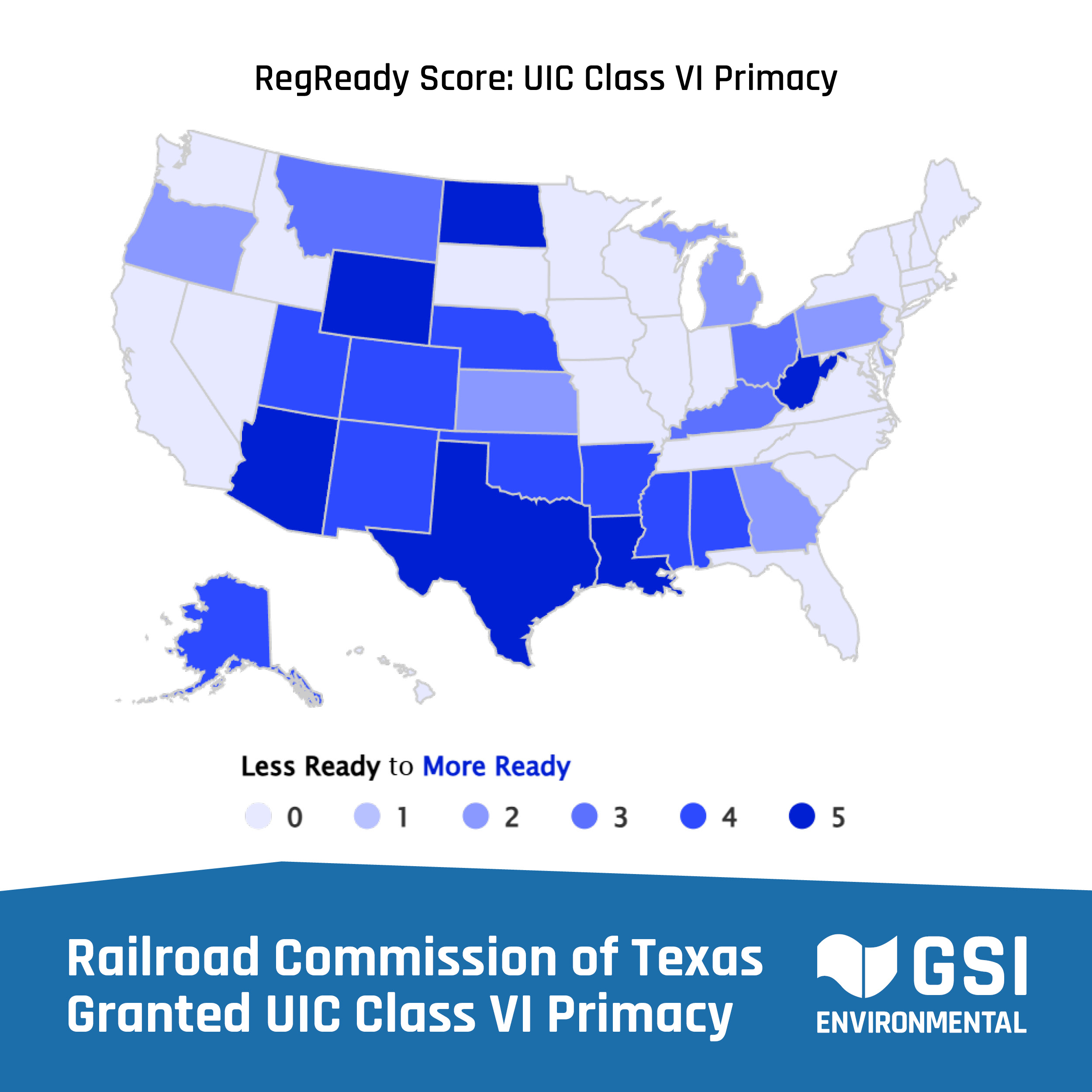
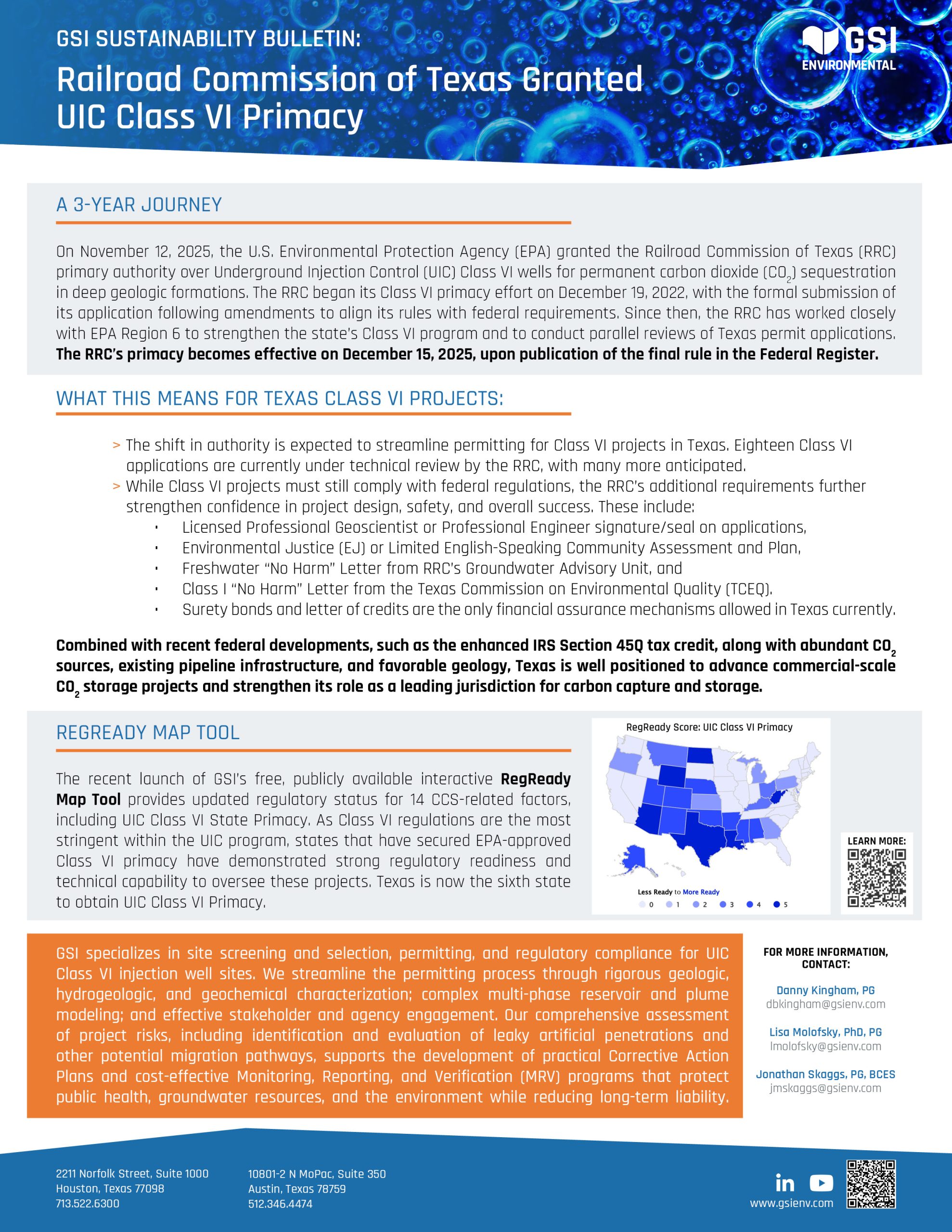
Big News for Texas Carbon Capture and Storage (CCS) Projects: The EPA has officially granted the Railroad Commission of Texas (RRC) UIC Class VI primacy, giving the state primary authority over Class VI CO₂ injection wells starting December 15, 2025.
Why this Matters: Texas CCS developers can expect more streamlined UIC Class VI permitting and effective stakeholder and agency engagement. With 18 applications already under review, and many more coming, this shift is a major step toward accelerating commercial-scale CO₂ storage projects across the state.
Combined with enhanced federal IRS 45Q tax credits, suitable geology, and existing infrastructure, Texas is now positioned as one of the most competitive jurisdictions in the U.S. for CCS development.
GSI has supported UIC Class VI projects nationwide with:
✔ Site screening and geologic/hydrogeologic characterization
✔ Class VI permit preparation and regulator-ready submittals
✔ Multi-phase reservoir modeling
✔ Practical and cost-effective testing and monitoring plan design and implementation
✔ Stakeholder and agency engagement
✔ Detailed artificial penetration review and Corrective Action Plan design
✔ Water resource assessments
✔ Alignment with IRS 45Q, LCFS, and EPA GHG reporting requirements
We support clients with strong, regulator-ready applications that keep projects moving efficiently from feasibility through permitting and operation. Reach out to learn how GSI can support your Class VI project.
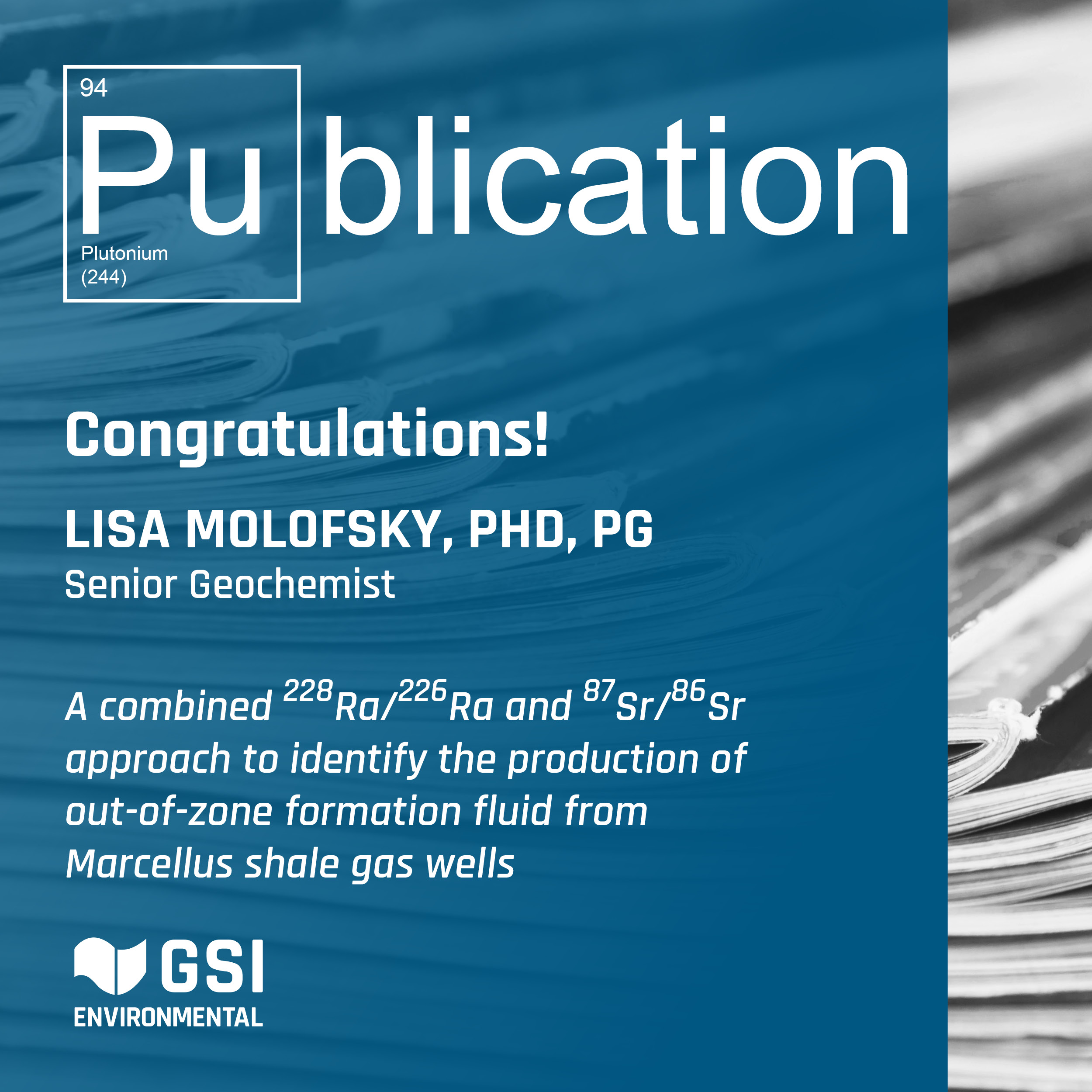
Lisa Molofsky, PhD, PG has co-authored a new article titled "A combined 228Ra/226Ra and 87Sr/86Sr approach to identify the production of out-of-zone formation...
Lisa Molofsky, PhD, PG has co-authored a new article titled “A combined 228Ra/226Ra and 87Sr/86Sr approach to identify the production of out-of-zone formation fluid from Marcellus shale gas wells,” published in Applied Geochemistry.
This article, co-authored with M.A. Engle, T.W. Wagner, A.S. Wylie, and D.P. Fernandez, presents a geochemical method that combines radium and strontium isotope ratios to determine the origin of high-salinity fluids produced from Marcellus shale gas wells. The study provides valuable insights into identifying out-of-zone water production and offers a framework that could be applied to other oil and gas basins.
GSI has released Version 2.6.0 of USG-Transport (USGT), our advanced groundwater modeling tool for structured and unstructured grids. This latest update includes...
GSI has released Version 2.6.0 of USG-Transport (USGT), our advanced groundwater modeling tool for structured and unstructured grids. This latest update includes expanded capabilities, bug fixes, and documentation updates that support more flexible modeling and improved accuracy.
What’s new in Version 2.6.0?
• DRT: Now supports multiple return flow cells per drain cell, allowing more uniform water distribution across recharge zones or agricultural fields
• BCT: Added Variable Solubility option to account for spatial variability in solubility parameters
• New documentation provides guidance for simulating evapotranspiration in variably saturated soils using the EVT or ETS packages
The update also includes example datasets and a ReadMe file outlining the changes.
USGT supports a wide range of groundwater and solute transport processes, including:
• PFAS and heat transport in vadose and saturated zones
• Connected linear networks (CLNs) for modeling wells, streams, wetlands, and infrastructure
• Saturated and unsaturated flow using the 3-D Richards Equation
• Dual porosity and multicomponent transport with chain decay
• Borehole Heat Exchangers (BHEs)
• Density-dependent flow and transport
• Advanced recharge and extraction options through the QRT and DRT packages
• PHREEQC integration available as a separate executable
• Support for GUIs, PEST utilities, and particle tracking
GSI’s Hassan Javed and Graham K. Ansell, together with co-authors Frank Adamsky, Marco Malvasi, Paige K. Mulvaney, Pier Antonio Guarda, Robert H. Moffett, Simone Genna, Steve Johnston and Xian Liang, have published a study titled “A Critical Review of the Application of Polymer of Low Concern and Regulatory Criteria to Perfluoropolyethers” in Journal of Fluorine Chemistry.
The paper examines perfluoropolyethers (PFPEs), a class of polymeric PFAS widely used as lubricants in aerospace, healthcare, automotive, and other sectors, and evaluates them against Polymers of Low Concern (PLC) criteria. The study finds that PFPEs, owing to their high stability, negligible bioaccumulation, and distinct physicochemical characteristics, pose minimal risk to human health and the environment. The authors emphasize that PFPEs should be evaluated as a separate class for regulatory purposes, distinct from non-polymeric PFAS.